Showing posts with label travel. Show all posts

Monday, May 14, 2012

Lens selection for a trip to Scotland?

Question

In a few months I'll be going to Scotland for a holiday (highlands and so on). So far, along with my 550D I have the standard kit lens 18-55mm, and I have recently bought the 55-250mm II. I am planning to buy an other lens, either the canon 50mm f1.4 or the canon 10-22mm.

I like the 50mm because it lets a lot of light in and it can be used in the evenings without using much flash in low-light conditions, not to mention the delicious bokeh!. However I have always liked the effects of the 10-22mm as well. And I understand that it's more creatively versatile and I can use it for Scotland highlands and castles

Eventually i'll be buying both, but I am stuck over which one should I get before the holiday. Which lens would you get if you were faced with the same dilemma? Budget not an issue, preferably I just want to get one of those only before august!.

Thanks Luke

Asked by The Alchemist

Answer

I'm trying to think of the usual subjects that you might encounter on a trip to Scotland.

  1. The landscape
  2. Ancient and modern architecture
  3. Details - a glass of whisky, gargoyles, moss, cobbled streets, and so forth
  4. Wildlife

For landscape photos I would suggest you can get away with your kit lens, but the 10-22 is a great option here.

For architecture the 10-22mm also works well, although you might need a tripod for darker shots as the aperture doesn't open up as much.

The detail shots is where the 50mm 1.4 would work reasonably well, especially as you suggest for the bokeh. However, you can get good macro and reasonable bokeh with the kit lens, and the image stabilisation on there will also help in darker conditions.

Finally, you have the wildlife aspect reasonably well covered by the 55-250mm, although I would recommend a tripod or preferably monopod for a long shot on a gloomy day.

Overall I would probably recommend the 10-22mm as it's a great lens that gives you a lot more options. You can always get the 50mm 1.8 instead of the 1.4 if you've a spare £90 lying around.

Answered by Maynard Case

Tuesday, April 17, 2012

How can I backup my RAW photos while travelling without Internet access?

Question

This question seems similar to this one, but my needs are different :

  • I shoot in RAW exclusively
  • I'm looking for a 100% offline solution: while traveling, Internet won't be accessible
  • the "laptop" solution is too heavy for me: I'm looking for a lightweight solution
  • the simplest, the better: one device to rule them all

EDIT: I'm using good old Compact Flash cards (yes, the bigger ones), so I need a device that can read it. If it can read from other cards, this question might be interesting for more people than myself - that's the whole purpose of the website.

Answer

If I'm feeling paranoid about backing up, I use a Nexto DI, which can backup a card directly to its own internal drive.

It reads CF/SD/SDHC, doubles as a USB2/external SATA drive, and is much faster than most of the other similar products I could find. (There are a bunch of similar products available, but this one had the best reviews at the time, about 6 months ago.)

Answered by Matt Bishop

Saturday, April 14, 2012

Is there an alternative to AA cells for the Fujifilm HS20?

Question

After getting into a choice between two super zooms, the Canon SX30IS or Fujifilm HS10 / HS20, I have chosen Fuji. However, it uses AA batteries. When on tour it's so painful if AA batteries go out or low.

Is it possible to have an additional good battery source (lithium, etc.) which can last a long time and can connect to tye Fujifilm HS10 / HS20 using a cable or something, so that even if the camera does not have AA cells it will still work?

Perhaps something which is there for old SLR cameras, or flashes that professional photographer use on wedding photography, or outdoors.

Asked by Anil Namde

Answer

As I understand it, the OP is asking for an external battery pack to power his Fuji HS 10 / HS 20 so that he can get extended battery life.

To do this you need the following
1. AC-5VX power adapter from Fujifilm and third parties.
2. CP-04 DC coupler from Fujifilm and third parties.
3. Duracell PowerSource Mobile 100 External battery pack + DC to AC power inverter - Lithium ion 4 Ah

The Duracell PowerSource has an AC power outlet(as well as two USB outlets!). Connect the AC-5VX power adapter to this. Then use the CP-04 DC coupler to connect the power adapter to the camera. One end slots into the camera's battery compartment.

Now you have in effect an external 4 Ah battery which should keep you going for a good while, to say nothing of the benefits for your other devices.

The downside is that you will have a bit of a cable tangle to manage.

There are other external power supplies to be had. I merely use the Duracell one as a good example of the genre.

Answered by labnut

Wednesday, February 15, 2012

How to use a tripod on the beach without damaging it?

Question

The site already has a good example of what to consider in regards to camera and lenses around sand, but I specifically am wondering what considerations to make when using a tripod near sand. Many years ago I took a cheap tripod with lever style legs, and sand really wrecked the entire tripod. I am hoping this time to avoid that issue. Is there a style of tripod that might be better, and how can I use it in such a way to limit any long term damage?

I don't have any specific shots in mind, just likely some long exposure night shots of the beach resort, and I might get it out in the day time for some self portraits.

Asked by dpollitt

Answer

In addition to @Itai's answer, I'd like to add, if you don't want to spend 1200$ on a tripod just to protect it from sands, you can use a little care, or on extreme situations, alternative DIY methods.

I also wrecked a tripod (not totally wrecked, but the sands kind of jammed the levers on the legs) by using it near a beach on a windy day. The next time I took some plastic (polythene) bags, cut them into long pieces (3" width) and adhesive tapes to put them around the leg lever joints like bandages. Worked like a charm. The only problem is, once you tape them in, you lose the ability to adjust the tripod height by extending the legs, otherwise this is good enough if you're not planning to go all out beach shooting. Adjust the tripod height before applying the tapes and you're good to go for that day.

And after the shooting, get to a safe place and use a rocket blower to blow off any accidental remaining sand particles near the lever joints just to be on the safe side.

DISCLAIMER: This method doesn't look pretty.

Additional Tips:

  • Accept the fact that a tripod is a tool, it's OK if it gets dirty. Metal tripods will eventually corrode if you expose it to salt water on a regular basis. Get a carbon fiber tripod to prevent corrosion.
  • Make it a practice to always extend the lowest section to keep the joints out of the sand.
  • A broad sand "shoe" is useful in both sand and mud to keep the leg from sinking.
  • If the tripod gets dirty, keep it extended until you can clean it.
  • Any decent quality tripod will take many, many years to corrode to the point it really matters with occasional exposure to sand/salt water. So, open up all the legs, wash and rinse it thoroughly using clean water and wipe it dry before storing it.
Answered by ShutterBug

Wednesday, January 11, 2012

How to carry a DSLR on a motorcycle?

Question

I do a lot of road trips and I carry my camera (D90+50mm) and an extra lens (18-105mm) in my backpack (Lowpro CompuDaypack). The backpack is great, but it doesn't allow me to draw my cam out quickly to capture a quick moment. I tried hanging the camera to my neck and that felt too dangerous!

I was wondering whether there is any other type of camera bag or holder with the "quick draw" feature. Also, I would prefer if it can be attached to my bike itself or if it can be kept on the front side of my body (as opposed to the backpack).

I also have a tripod (Slik F133) which came with a pouch that i use to carry on my shoulder (very uncomfortable) as it doesn't fit in my backpack. Is there any more convenient way to carry it? "quick draw" feature is not required for this one though.

Answer

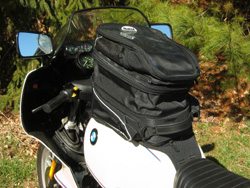
What about buying a decent sized tank bag and padding that out a bit? If you use a magnetic tank bag you might have to be mindful of where they are in relation to the camera gear although they don't usually seem to be under the bag itself, rather on flaps to the sides.

You could keep the camera sat in there with quite a long lens on it (most tank bags are fairly long) so the lens faces away from you. Once you have stopped unzipping and drawing your camera will be about as quick as you can get whilst keeping your camera safe during the journey...

A chap appears to have tried it here.

Some tank bags can be quite large - I used to ride with one about this size without any issues: link

Or something like this or this

Sunday, January 8, 2012

Carrying a dSLR on a motorcycle?

Question

I do a lot of road trips and I carry my camera (D90+50mm) and an extra lens (18-105mm) in my backpack (lowpro compudaypack). The backpack is great, but it doesn't allow me to draw my cam out quickly to capture a quick moment. I tried hanging the camera to my neck and that felt too dangerous!

I was wondering weather there is any other type of camera bag or holder with the "quick draw" feature. Also, I would prefer if it can be attached to my bike itself or if it can be kept on the front side of my body (as opposed to the backpack).

I also have a tripod (Slik F133) which came with a pouch that i use to carry on my shoulder (very uncomfortable) as it doesn't fit in my backpack. Is there any more convenient way to carry it? "quick draw" feature is not required for this one though.

Answer

What about buying a decent sized tank bag and padding that out a bit? If you use a magnetic tank bag you might have to be mindful of where they are in relation to the camera gear although they don't usually seem to be under the bag itself, rather on flaps to the sides.

You could keep the camera sat in there with quite a long lens on it (most tank bags are fairly long) so the lens faces away from you. Once you have stopped unzipping and drawing your camera will be about as quick as you can get whilst keeping your camera safe during the journey...

A chap appears to have tried it here.

Some tank bags can be quite large - I used to ride with one about this size without any issues: link

Or something like this or this

Wednesday, January 4, 2012

What lenses would best comprise a travel photography kit?

Question

On a crop sensor camera, eg Canon 7D, what would be the best kit to travel with around Europe for a few weeks? My shooting style will focus on landscape, architecture, and general purpose travel shots(Of note would be my lack of interest for portraits).

  • Limit to around 1-3 lenses, and I prefer light ones.
  • Crop sensor camera chosen to save on weight over a full frame option.
  • Question is open to all brands for general guidance, but I will be using a Canon body.
  • Cost is not a factor, I will rent the lenses I do not already own.
  • Quality is of paramount importance.
  • I will not have a tripod.

I understand some may consider this subjective, but I do believe that for a crop sensor body, with weight as a consideration, and a limit to the amount of lenses, a true best kit can be determined.

Answer

I literally just got back (a few days ago) from spending a few weeks in Europe with my 7D, 10-22mm, 17-55mm, 50mm and 55-250mm. I too have little interest in portraits, and took a lot of landscapes, architecture and "detail" shots on my trip. And I left my tripod at home... so perhaps some of my experiences/thoughts will be useful...

I carried the 3 zooms around with me most of the time, occasionally taking the 50mm out, and if I wasn't really feeling up to carrying it all, I'd just take the 17-55. I remember at the time thinking the 10-22 and 55-250 were by far the most useful lenses, though oddly the proportion of all photos from each lens was:

  • EF-S 17-55mm f/2.8 IS USM — 44%
  • EF-S 55-250mm f/4-5.6 — 28%
  • EF-S 10-22mm f/3.5-4.5 USM — 24%
  • EF 50mm f/1.8 II — 4%

I've yet to sort through my photos, so if I remember I'll come back and update the percentages based on the photos I actually liked (; I'm quite sure the best will be from the wide and telephoto.

I remember thinking often that I'd have probably been happier with the 10-22mm and a better telephoto (70-200 f/4L or 70-300L), and just a 30mm in the middle (for weight reasons). The other thing I wanted was a second body... As much as I like my 17-55 (especially if it's the only lens I'm carrying), I have a feeling that two bodies, one with a good wide angle, the other a good telephoto, and a 'normal' (30mm for crop) prime in the bag, just in case, is all one really needs... but it's hard to justify a second body just to be switching lenses less frequently! But for travel or events, when lots of things are new and unexpected, it seems to make sense.

I found the 10-22mm great for the big old churches, even though the 17-55 has a wider aperture, 17mm just didn't cut it in some of them. I think a similar lens that goes as wide as 11 or 12mm would also be fine (e.g. Sigma/Tamron/Tokina offerings), but the 17 or 18mm wide end of 'normal zooms' wouldn't cut it.

The tele was great for odd details, especially interesting people (I'm not one to approach people to take a photo), a bit of wildlife and the like. Mine's the kit one I got with my 450D a few years back which I'm saving up to replace with something with a wider aperture, but even so it was very useful and sufficient quality at f/8 to f/16.

The 17-55 was most useful when I didn't want to carry a lot, since its kind of wide and kind of long, so I'd probably still take it again, (even if I had a 30mm prime), unless I was expecting to have all my gear with me at all times, and wouldn't be comfortable leaving it behind somewhere on shorter day trips.

So if you want to stick to 3 lenses, I'd suggest an ultra-wide like the Canon 10-22mm, a good tele zoom like the 70-200 f/4L IS USM (or 70-300 if you like wildlife which I usually find I'm wanting more than 250 for) and a 30mm prime like the Sigma 30mm f/1.4 HSM.

Edit: I guess if you're aiming for highest quality, I should be suggesting the 35mm f/1.4L instead of the Sigma.

Edit 2: In hindsight, with a bigger gap than I had between the wide and zoom (i.e. 22 to 70mm instead of just 22 to 55mm, you may be wanting more than just a 30mm or 35mm prime in the middle there... especially if you don't already have a 30mm and use it regularly enough to be comfortable with it!)

Wednesday, December 14, 2011

For a point-and-shoot travel camera, what features matter the most?

Question

For a GPS-enabled point-and-shoot camera mainly to be used when traveling and hiking, what specific features or criteria can be used to narrow the field of possible cameras?

Ideally this camera would also be good for capturing everyday outings.


Original Question:

I'm a noob photographer who needs the camera mainly for snapshots. Particularly there are three opportunities when I take pictures, ordered by priority:

  1. Taking pictures while traveling. There I want to make pictures of sights, but also landscape or persons
  2. Taking pictures when hiking, both in the summer and during winter.
  3. Taking pictures when going out and having fun

So as you can see these are three very different kind of pictures. Additionally, I have some further requirements. It is absolutely necessary that the camera supports automatic geo-tagging with GPS and it should not be too heavy since I'm carrying it even when doing sports.

Based on these features (not too big, geo-tagging), I have selected all possible cameras on www.digitec.ch. The problem now is that there are almost 100 possible candidates. So what additional criteria can I use to choose a camera?

Answer

For a camera that's going to be used during hiking and sporting, drop and weather resistance might be beneficial. You can find those cameras by selecting the "Waterproof" options.

"Going out and having fun" suggests looking for good light gathering ability for better quality of low-light shots and faster shutter speeds in action shots. This is usually achieved through larger sensor size and lenses with smaller f-number. Unfortunately there are no search options on Digitec for such info; you might have to skim some reviews and look for "low light performance", "high ISO handling" or something similar.

Tuesday, December 6, 2011

Are airport x-ray scanners safe for DSLRs / lenses / storage media?

Question

While traveling by air here in India, one is instructed to remove all electronics like cell phones / media players / laptops and pass them thru the X-ray scanners separate from the rest of one's hand baggage (carry-on).

Is a modern-day DSLR (specifically a Nikon D90 / D3100) and the SD card contained within affected? Is is safe to pass it thru or do I insist on a manual check and bypass the X-ray machine if possible?

Answer

I've done a lot of travel with dSLR equipment and cards, I've never had an issue, it's safe to send through. The issue, historically, was with film since x-rays are light and could affect the film.

Sunday, November 20, 2011

How important are in-depth reviews when selecting a compact camera?

Question

I'm going to buy a super-zoom compact camera for my travels and I'm reading a lot of reviews to find which one best suites my needs.

I though that a good camera should result good in all reviews, but this is not: for one review a camera gives good pictures, for another not; a review highlights some cons (e.g. slow operation), which are not even mentioned by another...

So, here is the question: as far as a not-professional cameras are concerned, can we say that nowadays all cameras are good enough to a satisfy an enthusiast photographer (and so, reviews can only point out minor issues) or should I take into account those "pixel-level" reviews?

Answer

No, I do not think that cameras are 'good enough' for an enthusiast photographer that they should simply assume any one will satisfy their needs OR that a buyer should take the manufacture's word for it.

An enthusiast understands features and has a sense of what features are most important to him or her. Knowing which camera truly provides those features is important. For example, most cameras state they offer high-ISO, but often get there with different methods, many leading to significant noise, or shutter speed trade-offs. Camera reviews are essential to understanding these trade-offs.

Each camera provides trade-offs, and remember that pricing has little to do with cost, and everything to do with image. In other words, cameras are priced to place them in a category more than to reflect the cost of manufacture. A Canon 60D does not likely cost much more than a Canon 1000D, but is priced higher to place it in the enthusiast, or semi-pro category.

I think comparing ACROSS reviews is difficult at best, and misleading at worst. Because each review 'site' uses different criteria and values different things in cameras, trying to garner a consensus from several sites will only end in confusion and frustration.

Several sites have a defined evaluation process and method and repeat this for each review. These sites have significant consistency, and allow direct comparison of one camera to the other. Sites such as DPReview.com, imaging-resource.com, Steve's DigiCam are good, established sites.

Saturday, October 8, 2011

Gear for carrying and storing a DSLR on a backpacking trip?

Question

I'm planning on going on a short backpacking trip at the end of this month and would like to take along my DSLR. What are some good options for me to carry and store my camera and a tripod if I'm also carrying around a big hiking backpack with me?

Specific to my situation, I'd like to consider cheaper options as I don't plan on backpacking enough to make a considerable investment.

Thanks guys!

Answer

Having the camera accessible is critically important to get a variety of shots along the way. Huge backpacks are not ideal for this. I used a Top-Loading zoom bag when I carried fewer lenses ;) This bag is quite cheap and will serve you in the future too, it comes in different sizes and colors.

The tripod should easily be able to be attached to your backpack. Below is good for a small one or on the side. Most backpacks have plenty of straps or at least loops where you can attach straps to hold additional items. If you use a Gorillapod SLR-Zoom, then it is even better to hook it somewhere you can reach. I often simply loop its legs around the camera bag strap and barely notice it.

Tuesday, September 27, 2011

How to carry film through airports?

Question

I had a business trip with some free time in the evening, so I took my photo gear with me, but on the last moment, decided to leave my film camera at home because I did not want to ruin the film with X-ray scans in airports. I wasn't going to stay long enough to buy, shoot and develop a film during my stay, which seems to be the best way of avoiding X-ray scans.

I want to be better prepared next time, so what would the best practice to travel with undeveloped film?

Answer

  • The scanners for checked baggage are a lot more powerful, so take it through in your carry-on.
  • If you've only got slower films (ISO 100 or so), there's not really a concern.
  • If you have faster films, ask to have them hand-inspected. With anything ISO 400 and below you should be fine but you can have issues if they go through the scanner too many times or decide to blast your bag with more juice because all your big metal cameras look suspicious.
  • If you're going to have them hand-inspected, put all your film in a zip-loc bag, and put that on an outside pocket or something so you can yank it out easily (i.e., like your 3oz bottles of liquid).
  • Keep your camera(s) un-loaded in case the agent wants to open them. I've never had that happen, but you never know these days...

Tuesday, August 16, 2011

How should I pack equipment when travelling in countries with high crime rates?

Question

I'm going to travel individually in Sub-Saharan Africa where the crime rate is high. Most of the time I will do landscape photography and only a few shots in urban areas. I've been there already, but without valuable camera gear. I'm not sure if I should strip down my equipment to low budget but evidently suffer loss of quality and focal range.

How do you pack your stuff when travelling such regions? What is your experience?

Answer

I live in a country where crime-rate is quite high but that doesn't prevent the photographers here from buying/using expensive gears. All you have to do is be a little more careful than usual. I'd suggest:

  1. Avoid lone journeys. If possible gather a group of people.
  2. Use public transports as much as possible avoiding taxis.
  3. Try to avoid late night and too early in the morning shootings.
  4. Be as inconspicuous as possible. Prefer black lenses over the white ones!
  5. Ask hotel/resort manager about the place before going to shoot there.
  6. If possible, ask someone local to assist/accompany you during your walks.
  7. Do not carry any company branded (Canon/Nikon etc) camera bag. Use something that doesn't make it obvious that you're carrying expensive gears.

One of my friends once got in the hand of a group of thugs. He introduced himself as a journalist of a local leading newspaper and later successfully managed to escape them paying a few dollars only for their treat. Just in case, you might use the trick! =)

EDIT: It just came to mind, several companies offer insurance for your photographic equipments. If you're seriously worried, you can try reading through their offers and get a suitable plan for you. A simple google search helps!

Monday, August 8, 2011

What equipment should I purchase for a trip to Mongolia?

Question

I'm flying soon to Mongolia for a few weeks and I'm still somewhat of a beginner to photography, at least equipment-wise! So, I'm looking for equipment advice mostly. I currently have a Canon EOS 400D with an 18-55mm lens, and I recently purchased a 50mm F/1.8 prime (can't wait for it to arrive!), but I realize that to properly capture the open plains and skies of Mongolia, I'm going to need a wide angle.

I don't have a massive budget to spend, and to be honest, I've been a bit rough on my camera in the past and don't want to bring a long an expensive lens while I'm backpacking. Is my 18-55 going to be good enough? I'm definitely willing to purchase a new lens to take with me, and I would prefer something that would stay useful to me after Mongolia when I move to a city for a bit (heading to Sydney, Australia!).

Also, what would be the right filter to bring along? I don't know much about those and only have a UV filter at the moment.

Answer

I spent a while in Mongolia and frankly I think that what you (will) have is fine, with some minor tweaks.

I'd add a good quality circular polarising filter for your kit lens as well (cheap ones have weird colour casts, good ones are colour-neutral at all angles).

For super-wide shots, I was quite happy with stitched 17mm shots. I don't think wide lens is a must. MS has a free stitcher that does a fair job if you make an effort to rotate your camera sensibly close to the lens' nodal point.

Night-time photography is also possible and with the crystal-clear skies I'd heartily recommend it. Watch out for the sharp temperature changes to night-time and the resulting condensation on your equipment. Also bear in mind that your batteries will have a significantly lower charge at low temperatures so it's worth keeping your spares close to body heat. A tripod isn't absolutely necessary if you find convenient resting places for your camera.

Unless you're in Ulaanbataar you might not find convenient charging points, so battery-saving measures make sense (disable review, lower lcd brightness, keep batteries out of camera unless shooting...) and I'd consider packing some spare memory cards too.

If you've got a point+shoot camera, bring it with you - you won't always have the time to whip out your dSLR ;-)

Lastly, I'd strongly recommend lots of practice of the various shots you'll be taking so you can spend more time enjoying the experience and less time setting up shots; having a list to hand of the shots you know you want is also quite helpful.

Oh yes, and expect your gear to get fairly dusty, no matter how much care you take to keep it clean. Dust spots can be removed after the fact fairly easily in any case.

What to purchase for a trip to Mongolia + shooting advice

Question

I'm looking for equipment advice mostly. I'm flying soon to Mongolia for a few weeks and im still somewhat of a beginner to photography, at least equipment-wise anyways! I currently have a Canon EOS 400d with an 18-55 lens, and I recently purchased a 50mm F/1.8 prime (cant wait for it to arrive!), but I realize that to properly capture the open plains and skies of Mongolia, I'm going to need a wide angle.

I don't have a massive budget to spend, and to be honest, I've been a bit rough on my camera in the past and dont want to bring a long an expensive lens while I'm backpacking. Is my 18-55 going to be good enough? I'm definitely willing to purchase a new lens to take with me and I would prefer something that would stay useful to me after Mongolia when I move to a city for a bit (heading to Sydney, Australia!) Also, what would be the right filter to bring along? I don't know much about those and only have a UV filter at the moment.

Thanks in advance for any advice, and some good tips on landscape photography would be awesome!

Nat.

Answer

I spent a while in Mongolia and frankly I think that what you (will) have is fine, with some minor tweaks.

I'd add a good quality circular polarising filter for your kit lens as well (cheap ones have weird colour casts, good ones are colour-neutral at all angles).

For super-wide shots, I was quite happy with stitched 17mm shots. I don't think wide lens is a must. MS has a free stitcher that does a fair job if you make an effort to rotate your camera sensibly close to the lens' nodal point.

Night-time photography is also possible and with the crystal-clear skies I'd heartily recommend it. Watch out for the sharp temperature changes to night-time and the resulting condensation on your equipment. Also bear in mind that your batteries will have a significantly lower charge at low temperatures so it's worth keeping your spares close to body heat. A tripod isn't absolutely necessary if you find convenient resting places for your camera.

Unless you're in Ulaanbataar you might not find convenient charging points, so battery-saving measures make sense (disable review, lower lcd brightness, keep batteries out of camera unless shooting...) and I'd consider packing some spare memory cards too.

If you've got a point+shoot camera, bring it with you - you won't always have the time to whip out your dSLR ;-)

Lastly, I'd strongly recommend lots of practice of the various shots you'll be taking so you can spend more time enjoying the experience and less time setting up shots; having a list to hand of the shots you know you want is also quite helpful.

Oh yes, and expect your gear to get fairly dusty, no matter how much care you take to keep it clean. Dust spots can be removed after the fact fairly easily in any case.

Sunday, July 17, 2011

How would I get my travel photos published?

Question

I'm an avid traveller and photographer, and I've got some cool travel pics. I'm not looking for money, just the recognition and satisfaction in knowing that my photos are good and useful enough to be published by a reputable publication house. I took a look at the usual suspects like Nat Geo and Travel+Leisure, but of course competition is really tight. Seems like everyone is a photographer today. I did post one photo to Nat Geo's MyShot section, so fingers crossed, but small chance.

Any advice?

Answer

I realize this probably isn't Exactly what you're looking for (because it is a bit of cold water in the face, potentially), but hopefully you'll find it helpful anyway... There are three main reasons that photographers get their work published:

  1. They differentiate. What makes your photographs different than every other photographer's photographs? If you don't know what the answer to this question is, you will simply not get published. The cold, hard fact is that in all likelihood every photo editor you will ever come in contact with has seen exactly what you are offering a thousand times... unless you figure out right now before you start taking more pictures how your photographs are going to be different than every other photographer out there and then take all your pictures that way and work that angle to the bone.

    The thing that makes your work different cannot be:

    • The location or subject matter of your photographs is so unique and different (unless you're taking pictures on Mars, you don't have the market cornered on unique locations or subject matter)
    • The technical proficiency of your work (Everybody's work will be as technically proficient as yours... Your work must be technically perfect just to be in the game at all)
    • The cool post-production effects you use (Leave the heavy Photoshopping at home, only amateurs do more than basic color correction, cropping, levels, dodging and burning)
    • How pretty your pictures are (Anybody can take a pretty picture. If your picture isn't saying something more profound than 'I'm pretty!' you're going to have trouble getting published)

    What does that leave for you to differentiate yourself with? Figure that out and you'll find publishing success.

  2. They network. Sorry to say, but the old cliche is true- it isn't what you know, it's who you know. Photo editors are human too. If they have the choice between someone they know and an unknown, most will choose the known quantity every time. The vast majority of editors are not out there 'lookin' to give a new guy his big break.' So how do you break through? Become known. There are a couple of ways to get known, but the absolute best way is to follow the advice in point #1 so the work stands out in the crowd of photographs that the photo editor will be looking through.

    Submit often, submit only your best stuff (never, never, never submit even a single photo to anyone that isn't of the highest quality. Never. Did I mention never?) and follow up with robot-like consistency. Ask for assignments. Even if they never result in publication, assignments can demonstrate that you're reliable and a 'go-getter.' Ask what a publisher has coming up in future issues and then take pictures that fit the requirements. Become someone who the photo editor (or at least the photo editor's receptionist) knows by name. If you've got a history of submitting exceptional work consistently (even if there wasn't room to publish it at the time you submitted it) editors will start to remember your name. And then one day you'll suddenly find yourself on the inside, instead of the outside.

  3. They work their @ss off. It's very simple... Part-timers don't get published. Now you can point me to dozens of part-timers who have been published once, twice, maybe even a few times over the course of a lifetime, sure... But you will never find a part-timer who publishes on a regular basis. "Now wait a second," you may say... "I can't afford to quit my job and be a full-time photographer! So there's no hope for me?" Ah... Here's the secret (minor secret though it may be)... Work your full-time job, and also work as a full-time photographer. Do that until photography becomes the full-time job.

    Now I say all of the above knowing full-well that you stated you weren't interested in getting paid, but another cold, hard truth is that part-timers may (or just as often they may not) get a few lucky shots published over the course of their life, but full-timers are working every day to generate enough output that they're no longer relying on luck to take the sorts of photographs that belong in publications... and there really isn't a whole lot of middle ground, unfortunately. If publication is your goal, then it cannot be reliably achieved as a part-timer.

Here's the thing... The above may sound harsh, or like a whole lot of work, and potentially it is both. But I've been a working professional photographer for 15+ years now and I'm speaking from experience when I say that you don't need a self-help book's worth of advice to get where you want to be. If you work these three angles like they're your last hope on earth you will become successful eventually (and probably sooner rather than later), and if you don't... You probably won't be. I've seen plenty of people go both ways over the years to know that the odds will favor you, or be against you purely based on how hard you work.

Thursday, July 14, 2011

What are good resources for Photographer's Rights around the world?

Question

As a photographer, I take a lot of pictures around the world. In the US, the rights for photographers are pretty clear cut, although harassment and bullying occur at the hands of security and law enforcement personnel. However, the rights for photographers in other countries are not always so clear.

What are some good resources for photographer's rights for around the world?

Answer

For UK, some info can be found at website of I'm a Photographer, not a Terrorist group, including a "bust card" which sums up your rights under British Terrorism Act.

Other than that, I can only comment on the situation in the Czech Republic, which seems to be pretty relaxed and free of any silly restrictions.

How can I backup my photos while travelling?

Question

I'm going travelling around the world for a year in September and am already panicking about how best to send my photos home while in various countries.

Requirements:

  • I only need to backup JPEG files (I don't shoot RAW bu that's another thread ;) )
  • I need to be able to upload in a web-based manner (I will be using internet cafes and so can't assume I can use FTP etc)
  • I need plenty of space, preferably unlimited (I racked up about 200GB last year)
  • I need to store the full image (no lossy compression is acceptable!)

Options I can think of:

  • Burning and posting DVDs (can I trust these in the post and not to get corrupt? it may be better than waiting for upload speed though...)
  • Flickr (I have a pro account but not sure how hard it'll be to get the photos back down again. Will I even be able to get the original snaps?)
  • Setting up a server at a friend's house and hosting some kind of file server with a web-app front end

What have other people done or does anyone else have a better idea?

-Matt

Answer

Depends on how much you value your shots. Last year my wife and I took a 5 month photographic trip and we took:

  • 1 Laptop: We had Lightroom to download and do a basic selection every night (out of focus pictures don't need to take any disk space!). Photoshop to do some basic retouches if we wanted to publish them on Flickr, etc. And a large enough HD to store the whole trip.

  • 6 4GB memory cards: we numbered them and made sure to rotate them correctly so we kept the pictures in there the longest possible time as backup. We rather use more cards with less GB to diversify risk. If you are in the middle of nowhere and your only 16 GB card breaks you are SOL.

  • 2 300GB USB HD: once the pictures were classified on the laptop we backed them up to one drive and mirrored on the other.

Online storage is not practical when you are travelling because of the time it takes to upload the amount of data you will generate. This way we felt very confident that we weren't going to lose any data, at any given time pictures were stored in up to 4 different places at the same time.

And to send home, select up to 5 pictures of each escapade and post them on Flickr. Selection is key.

Tuesday, July 12, 2011

In what situations should I use which lenses while traveling to Paris?

Question

I'll be travelling to Paris and I'll be bringing me with a Canon T2i/550D, a Canon EF-S 18-200mm f/3,5-5,6 IS and a Tokina 11-16mm f/2,8 (I could also bring a Canon EF 50mm f/1,8 II). I bought the Tokina yesterday so I have no experience with it or using such a wide angle lens and I'll have only a weekend to try it prior to the trip.

I'm an amateur still learning everytime I use my camera so my question might sound basic but in what situation/landmarks should I use these lenses when in Paris? Also, any tips on using my new ultra wide angle lens would be appreciated.

[Edit: Reading the comments, I realize now that the question was really not clear at all. My ititial thought was more about what lens should I bring when going to see monument A or museum B but thanks the experience of this forum amazing contributors, the real question is more about composition and what do I really want to capture and for that, there are no clear answers but many thanks for letting me see the issue from an artistic point of view instead of a technical point of view.]

Answer

Choosing the right lens

It looks like you have a pretty solid range of focal lengths covering everything from 11mm through 200mm. Not a bad set of lenses to work with. One thing that should be noted is that lugging around all that gear might get tiresome after a while, so you might want to think about picking a particular lens to bring if you don't want to go lugging weight around.

As to when to use which lens, I guess there are a few factors that go into that decision: what you want to capture, how much your scene should encompass, and how much reach you need to achieve the previous two. Once you have decided on these three things, and chosen a lens, you should try to achieve the composition you desire. You may find that you end up wanting to photograph a single scene with more than one lens, and thats where art and personal style will come into play. So, without further ado...

Answering the questions

What scene do you wish to capture?

Before you can pick a lens, you need to decide what scene you wish to capture. You have three lenses that cover a fairly broad range of common focal length "buckets": ultra-wide & wide angle, standard/normal angle, and long/telephoto. As a general rule of thumb, the wider you go, the more encompassing your shots can be, and the longer (narrower) you go the less encompassing and more targeted your shots can be. It should also be noted that the maximum aperture of a lens also plays a role here, as wider apertures allow thinner DOF and blurrier backgrounds.

Some of the first things you should think about is what do you want to capture? Are you interested in photographing an entire city skyline at night? Do you want to capture a portrait of friends or family, with a nice creamy backdrop to guide the eye? Do you want to reach out over a noisy foreground and single out something in the distance? Do you want to capture a broad scene with great depth, but focus on a particular subject in the foreground?

How much of the world do you wish to encompass in a single scene?

A single photograph can be a lot of things...can encompass a broad, detailed scene with a lot of interesting elements, or a narrow, targeted, specific scene that focuses on a single subject...or something in-between those two. This is the scope of the photography you wish to take. There are different ways to achieve the scope you desire as well.

In the case of capturing a city skyline, your scope is very broad. Your intention is to bring in a considerable amount of the world you see before you, and keep as much of the detail present as you can. The desire is to create a broadly encompassing shot, which is probably best served by a wide angle lens. Ultra-wide and wide angles, such as 11-24mm, will help you bring in that entire city skyline, along with the waterfront reflecting it in the foreground (i.e. Marina Bay, Singapore @ 22mm). You can put a compositional twist on this scene, and bring in not only a broad scene at a distance, but also include strong foreground element: Photographing the city skyline from the corner of a bridge that stretches out across that waterfront foreground. Again, a wide-angle lens is going to be your friend here. In addition to allowing your photos to encompass a broad scope, wide angle lenses also allow you to simultaneously "get in close", and draw in a critical foreground element (i.e. Bridge in the Fog @ 20mm). Another element of scope is architecture itself. Rather than encompassing an entire city skyline, you may wish to capture an entire building in an artistic manner. You mentioned your trip was to Paris, where there are some of the worlds most renown architectural wonders. Another excellent use of wide angle lenses is capturing a building or city landmark, up close, from head to toe. (i.e. Eiffel Tower @ 18mm).

In contrast to scenes that encompass a broad scope are scenes that encompass a narrower scope. Portraits, for one, are usually intended to focus on a single element of a scene. A narrower field of view, and often a less distinct backdrop, can help narrow the scope of your photograph and focus on just one or a few things...such as a portrait of a girlfriend or wife, or maybe a group shot of some friends. The indistinct, yet present, backdrop of Paris might add an intriguing artistic element, yet not distract from the real intent of the photo...your friends and family. Sometimes you may simply notice something intriguing that you want to focus on, without bringing in a lot of other distracting elements. Focal lengths between 35mm and 135mm are often superb for this purpose (i.e. Mission Completed @ 105mm).

Finally, there may be times when you see something in the distance (or even not so distant) that makes for a superb photograph, but is mired by a lot of foreground "noise" and distraction. This is where your telephoto focal lengths and the added reach they provide come in particularly handy. Longer lenses have the ability to greatly reduce the scope of a scene, and focus on a very specific thing.

how much reach you need to photograph the scene you've chosen?

Reach is the final aspect of choosing a lens. When photographing a wide-angle scene, the reach of the lens is in the breadth of scope that it captures. You may find that too much reach is including elements of foreground or periphery that you don't want in your scene, in which case a less-wide angle is probably necessary. If 16mm is capturing parts of a cityscape that detract from your final vision, perhaps switching from the 11-16mm to the 18-200mm will allow you to narrow your scope a bit, and reduce the all-encompassing reach of wide-angle lenses.

On the opposite end of the spectrum, telephoto lenses offer a different kind of reach...the ability to "reach out" and "reach across". When you find that amazing photo of something off in the distance, such as the Eiffel Tower, but you find that your vision is mired by all the chaos of a foreground market, a telephoto lens that can reach out and beyond that noisy foreground, and zero in on just the Eiffel Tower in the distance, is probably the lens you want. A 200mm lens will do well here, such as your 18-200, or as is often the case...the wildly popular and higher quality 70-200mm lenses that many manufacturers offer.

Composing the shot

As a final step, it should be noted that once you have selected a focal length that meets your initial vision, don't forget to take some time to compose. Simply snapping a shot will certainly allow you to record your trip...but it won't necessarily help you tell a story about your trip, engage you in the art form of photography, or create particularly compelling photographs. It doesn't take long, but when you find the lens you need and frame your subject, think about composition...how the scene is divided, how much depth of field you include (or conversely, how blurry the background is), etc. Taking those few moments will help you craft a photographic story about your trip, and create more compelling photographs that you and your friends might hopefully enjoy more for a longer period of time. Some may even be frame-worthy and end up on your walls. ;)

On another note...you should also not limit yourself to a single focal length for any given scene. You may initially decide that using a 200mm focal length to photograph the Eiffel Tower is best. Your 200mm lens also happens to be a general-purpose lens that supports focal lengths that cover the entire range of buckets, from wide, to normal, to long and telephoto. Try out some alternative focal lengths, and compose a few additional shots. Maybe that "noisy" foreground has some intriguing elements in and of itself, and a slightly blurry Eiffel Tower as a backdrop could create an entirely new and different vision of your trip.

Last, after choosing a lens and composing your shots...don't forget to mind your camera settings. There is nothing worse than getting home and finding that you had your ISO far too high and all your photographs ended up horribly noisy, or that your aperture was not what you intended, and that blurry background turned out to be far more detailed and distracting than you desired.

Sunday, July 10, 2011

How does a tripod attach to the (front of the) Lowepro Pro Roller x200?

Question

I just bought a Lowepro Pro Roller x200. (Love it so far!) This one: Lowepro Pro Roller x200

enter image description here

It has a strap that attaches to the top left side, and a little holster like thingy that attaches to the bottom left side for holding a tripod. This works well.

However, it also, apparently has some way of allowing you to mount the tripod on the front. But I cannot figure out how to make it work. You can see from this picture from the Lowepro website that it is possible. But the documentation does not help and the picture is too small to figure out what is really going on (the top is obvious):

enter image description here

Note in this picture there is a little "tripod icon" right below the pockets on the front. enter image description here

This icon matches the icon on the little holster you can see holding the bottom of the tripod in the 2nd picture above. The question is how does this little holster attach to the front to the bag? There is a upside down pouch at the base of the front pocket with some velcro in it, but i can't see any way of getting the little holster to stick in place.

Anyone?

Answer

Never mind. Right after posting the question I poked around some more. I discovered that there is a nylon tab, with a loop for the holster strap to go through tucked in that little upside-down pocket!

I'd post a pic (i took one) but Stackexchange's photo upload appears to be broken right now.