Showing posts with label science. Show all posts

Wednesday, March 28, 2012

What is the lowest level of luminous flux a camera can detect?

Question

In the past, I've asked about taking photos of luciferase. Now I'm curious how weak of a light source I can detect. From How many photons per second is one Lumen? on Physics Stack Exchange, I can determine how many photons/sec makes one lumen. What then is the minimum amount of lumens needed for a camera to detect?

Asked by bobthejoe

Answer

Short: About 5 picolumen per pixel with the best commercial DSLRs such as a Nikon D3s.

Long :-) :

Minimum detectable light source will depend on camera and how much of the image area the source occupies. For best detectability, a source will be "brightest" if all it's energy arrives in a one pixel area. The image will not be very interesting in most cases :-).

But, to attempt to put a very approximate empirical answer to the question:

I'll make various assumptions along the way and summarise them at the end so they can be adjusted as desired.

1 EV is a bit above bright Moonlight and is correctly exposed at ISO 100 at f1 for 1 second.

1 EV = 1 lux = 1 lumen per square meter.

I'll avoid the temptation here to leap into steradians and candela and stick with more intuitive empirical terms :-).

Let's assume you are using a Nikon D3s which has a 12 megapixel sensor that can just about see in the dark with no photons at all.
At about 100,000 ISO and an exposure of one second at f1 at 1 EV and dark field subtraction you may perhaps have difficulty detecting whether a given pixel was illuminated or not as even a D3s is getting somewhat noisy. At around 12800 ISO there would be little doubt.

If you set your camera to image 1 square metre then then the 1 EV lighting will be providing 1 lumen total so the 12 million pixel sensor will be accepting ~1/12,000,000 th of a lumen per pixel.

That's at f1 and ISO 100 and 1 second exposure.
Increase ISO to 12800 as above and you can detect 1/12800th less light again.
1/12 million x 1/12800 ~= 6.5 x 10^-12 lumen = 6.5 picolumen.
I don't think I've seen picolumen used before :-)

So, if, all of:

  • You use an f1 lens

  • Your camera can image at ISO 12800 for one second at 1 lux or 1 EV and produce a discernible change in a given pixel

  • You have a 12 megapixel sensor

Then you can DETECT about 5 picolumen **in a single pixel area.
A Nikon D3S should do thus with relative ease.
Longer exposure times will produce increased sensitivities but in time noise will catch up with even a D3s.

Over the whole 12 megapixel sensor his corresponds to 78 microlumen which is 1/12800 th of a lumen total which is no surprise as it is just the inc=verse of the ISO setting when imaging a square metre at 1 lumen per squarre meter.

If you vary imaged area, aperture, ISO, sensor pixels, exposure time or camera capability then the answer will vary accordingly.

The biggest gain you can make with a given sensor is to cryo cool it.
And then there are advanced photo multiplying sensors that take the question away from the realm of "normal photography". eg Electron Multiplying CCD, Frame Transfer CCD, Intensified CCD, ...

See also:

Wikipedia astrophotography

Note: lumen is always 'singular'.

Answered by Russell McMahon

What is the lowest level of lumen a camera a camera can detect?

Question

In the past, I've asked about taking photos of luciferase. Now I'm curious how weak of a light source I can detect. From How many photons per second is one Lumen? on Physics Stack Exchange, I can determine how many photons/sec makes one lumen. What then is the minimum amount of lumens needed for a camera to detect?

Asked by bobthejoe

Answer

Short: About 5 picolumen per pixel with the best commercial DSLRs such as a Nikon D3s.

Long :-) :

Minimum detectable light source will depend on camera and how much of the image area the source occupies. For best detectability, a source will be "brightest" if all it's energy arrives in a one pixel area. The image will not be very interesting in most cases :-).

But, to attempt to put a very approximate empirical answer to the question:

I'll make various assumptions along the way and summarise them at the end so they can be adjusted as desired.

1 EV is a bit above bright Moonlight and is correctly exposed at ISO 100 at f1 for 1 second.

1 EV = 1 lux = 1 lumen per square meter.

I'll avoid the temptation here to leap into steradians and candela and stick with more intuitive empirical terms :-).

Let's assume you are using a Nikon D3s which has a 12 megapixel sensor that can just about see in the dark with no photons at all.
At about 100,000 ISO and an exposure of one second at f1 at 1 EV and dark field subtraction you may perhaps have difficulty detecting whether a given pixel was illuminated or not as even a D3s is getting somewhat noisy. At around 12800 ISO there would be little doubt.

If you set your camera to image 1 square metre then then the 1 EV lighting will be providing 1 lumen total so the 12 million pixel sensor will be accepting ~1/12,000,000 th of a lumen per pixel.

That's at f1 and ISO 100 and 1 second exposure.
Increase ISO to 12800 as above and you can detect 1/12800th less light again.
1/12 million x 1/12800 ~= 6.5 x 10^-12 lumen = 6.5 picolumen.
I don't think I've seen picolumen used before :-)

So, if, all of:

  • You use an f1 lens

  • Your camera can image at ISO 12800 for one second at 1 lux or 1 EV and produce a discernible change in a given pixel

  • You have a 12 megapixel sensor

Then you can DETECT about 5 picolumen **in a single pixel area.
A Nikon D3S should do thus with relative ease.
Longer exposure times will produce increased sensitivities but in time noise will catch up with even a D3s.

Over the whole 12 megapixel sensor his corresponds to 78 microlumen which is 1/12800 th of a lumen total which is no surprise as it is just the inc=verse of the ISO setting when imaging a square metre at 1 lumen per squarre meter.

If you vary imaged area, aperture, ISO, sensor pixels, exposure time or camera capability then the answer will vary accordingly.

The biggest gain you can make with a given sensor is to cryo cool it.
And then there are advanced photo multiplying sensors that take the question away from the realm of "normal photography". eg Electron Multiplying CCD, Frame Transfer CCD, Intensified CCD, ...

See also:

Wikipedia astrophotography

Note: lumen is always 'singular'.

Answered by Russell McMahon

Tuesday, March 27, 2012

What is the lowest level of lumens a camera a camera can detect?

Question

In the past, I've asked about taking photos of luciferase. Now I'm curious how weak of a light source I can detect. From How many photons per second is one Lumen? on Physics Stack Exchange, I can determine how many photons/sec makes one lumen. What then is the minimum amount of lumens needed for a camera to detect?

Asked by bobthejoe

Answer

Short: About 5 picolumen per pixel with the best commercial DSLRs such as a Nikon D3s.

Long :-) :

Minimum detectable light source will depend on camera and how much of the image area the source occupies. For best detectability, a source will be "brightest" if all it's energy arrives in a one pixel area. The image will not be very interesting in most cases :-).

But, to attempt to put a very approximate empirical answer to the question:

I'll make various assumptions along the way and summarise them at the end so they can be adjusted as desired.

1 EV is a bit above bright Moonlight and is correctly exposed at ISO 100 at f1 for 1 second.

1 EV = 1 lux = 1 lumen per square meter.

I'll avoid the temptation here to leap into steradians and candela and stick with more intuitive empirical terms :-).

Let's assume you are using a Nikon D3s which has a 12 megapixel sensor that can just about see in the dark with no photons at all.
At about 100,000 ISO and an exposure of one second at f1 at 1 EV and dark field subtraction you may perhaps have difficulty detecting whether a given pixel was illuminated or not as even a D3s is getting somewhat noisy. At around 12800 ISO there would be little doubt.

If you set your camera to image 1 square metre then then the 1 EV lighting will be providing 1 lumen total so the 12 million pixel sensor will be accepting ~1/12,000,000 th of a lumen per pixel.

That's at f1 and ISO 100 and 1 second exposure.
Increase ISO to 12800 as above and you can detect 1/12800th less light again.
1/12 million x 1/12800 ~= 6.5 x 10^-12 lumen = 6.5 picolumen.
I don't think I've seen picolumen used before :-)

So, if, all of:

  • You use an f1 lens

  • Your camera can image at ISO 12800 for one second at 1 lux or 1 EV and produce a discernible change in a given pixel

  • You have a 12 megapixel sensor

Then you can DETECT about 5 picolumen **in a single pixel area.
A Nikon D3S should do thus with relative ease.
Longer exposure times will produce increased sensitivities but in time noise will catch up with even a D3s.

Over the whole 12 megapixel sensor his corresponds to 78 microlumen which is 1/12800 th of a lumen total which is no surprise as it is just the inc=verse of the ISO setting when imaging a square metre at 1 lumen per squarre meter.

If you vary imaged area, aperture, ISO, sensor pixels, exposure time or camera capability then the answer will vary accordingly.

The biggest gain you can make with a given sensor is to cryo cool it.
And then there are advanced photo multiplying sensors that take the question away from the realm of "normal photography". eg Electron Multiplying CCD, Frame Transfer CCD, Intensified CCD, ...

See also:

Wikipedia astrophotography

Note: lumen is always 'singular'.

Answered by Russell McMahon

What range of lumen can a camera detect?

Question

In the past, I've asked about taking photos of luciferase. Now I'm curious how weak of a light source I can detect. From http://physics.stackexchange.com/q/880, I can determine how many photons/sec makes one lumen. What then is the minimum amount of lumens needed for a camera to detect?

Asked by bobthejoe

Answer

Short: About 5 picolumen per pixel with the best commercial DSLRs such as a Nikon D3s.

Long :-) :

Minimum detectable light source will depend on camera and how much of the image area the source occupies. For best detectability, a source will be "brightest" if all it's energy arrives in a one pixel area. The image will not be very interesting in most cases :-).

But, to attempt to put a very approximate empirical answer to the question:

I'll make various assumptions along the way and summarise them at the end so they can be adjusted as desired.

1 EV is a bit above bright Moonlight and is correctly exposed at ISO 100 at f1 for 1 second.

1 EV = 1 lux = 1 lumen per square meter.

I'll avoid the temptation here to leap into steradians and candela and stick with more intuitive empirical terms :-).

Let's assume you are using a Nikon D3s which has a 12 megapixel sensor that can just about see in the dark with no photons at all.
At about 100,000 ISO and an exposure of one second at f1 at 1 EV and dark field subtraction you may perhaps have difficulty detecting whether a given pixel was illuminated or not as even a D3s is getting somewhat noisy. At around 12800 ISO there would be little doubt.

If you set your camera to image 1 square metre then then the 1 EV lighting will be providing 1 lumen total so the 12 million pixel sensor will be accepting ~1/12,000,000 th of a lumen per pixel.

That's at f1 and ISO 100 and 1 second exposure.
Increase ISO to 12800 as above and you can detect 1/12800th less light again.
1/12 million x 1/12800 ~= 6.5 x 10^-12 lumen = 6.5 picolumen.
I don't think I've seen picolumen used before :-)

So, if, all of:

  • You use an f1 lens

  • Your camera can image at ISO 12800 for one second at 1 lux or 1 EV and produce a discernible change in a given pixel

  • You have a 12 megapixel sensor

Then you can DETECT about 5 picolumen **in a single pixel area.
A Nikon D3S should do thus with relative ease.
Longer exposure times will produce increased sensitivities but in time noise will catch up with even a D3s.

Over the whole 12 megapixel sensor his corresponds to 78 microlumen which is 1/12800 th of a lumen total which is no surprise as it is just the inc=verse of the ISO setting when imaging a square metre at 1 lumen per squarre meter.

If you vary imaged area, aperture, ISO, sensor pixels, exposure time or camera capability then the answer will vary accordingly.

The biggest gain you can make with a given sensor is to cryo cool it.
And then there are advanced photo multiplying sensors that take the question away from the realm of "normal photography". eg Electron Multiplying CCD, Frame Transfer CCD, Intensified CCD, ...

See also:

Wikipedia astrophotography

Note: lumen is always 'singular'.

Answered by Russell McMahon

Wednesday, March 7, 2012

What type of camera setup is required to take photos of luciferase?

Question

I'm working with luciferase which has a wavelength of blue 480 nm and I want to be able to take a photo of it. The trouble is, I can see the luciferase glowing in all of its glory in front of me but no matter how hard I try, I can't take a photo of the luciferase with my DSLR (Nikon D80) using a Nikon 50 mm lens and a Nikon 35 mm lens. I've tried removing the filters (Nikon L37 and Hoya UV).

I'm curious if I'm missing a certain lens/filter or if I should be shooting using a different lighting setup. I'm already exposing for 30" at f/22 on ISO 1600. Perhaps longer?

Asked by bobthejoe

Answer

That wavelength is certainly within the spectrum you can capture with any lens, with or without filters. Digital sensors capture between 350-1000nm If it is glowing, then you'd want that to be your main light source. Any additional light you throw onto it is going to dilute the glow from your subject and make it harder to see.

What aperture are you using? Unless this is incredibly dim, I can't imagine 30" not capturing something unless you're using a very small aperture.

Are you doing this in a dark room with a dark background? What do you see in your 30" exposures?

Through trial and error, you could do a range of shutter speeds (and ISO) to try to hone in on a good exposure value. If you can see it with your eyes, you should be able to photograph it without special equipment.

Answered by MikeW

Tuesday, October 18, 2011

What's a fairly simple way of taking a photo through a microscope?

Question

I have a simple microscope, with only one lens (though two eyepieces). Is there any way to do this, without too much money and modification?

Answer

If you have a SLR, it's as simple as pulling one of the microscope eyepieces, removing the SLR lens, and pointing the camera lens-box at the eyepiece hole.

You generally need to hold the camera about 1-2" from where the eyepiece sits.

enter image description here
Nikon D80 AF sensor

You lose contrast from light-leakage, but it works pretty well.

Tuesday, August 9, 2011

What is "solid angle" and how does it relate to photography?

Question

So, I was hanging out in the chat room, and hear mention of something called "Solid Angle". What is this, and how can it be important?

Answer

The solid angle is the extension of the concept of angle from two to three dimension. So let's start from 2d: consider a circle and pick two rays starting from the center. They will divide the circumference in two parts, called arcs. The length of each arc divided by the length of the radius will be the measure of the angle subtended by the arc itself.

Extend this to three dimensions: instead of a circle take a sphere, and instead of picking two rays pick a cone centered in the center of the sphere.The cone will cross the surface of the sphere: and now to define the solid angle measure the area of the surface delimited by the cone, divided by the square of the length of the radius (so that we have an area divided by an area).

The key point is that - since they are ratios - angles (and the solid ones make no exception) are dimensionless quantities: a small object as seen from a short distance can cover the same angle as a large object as seen from a long distance.

Why does this matter ? Because we live in 3 spatial dimensions ( :-) ). For instance consider a single light point source radiating (a star seen from very far?) By symmetry there is no reason for it to radiate more in one direction than in the other. So all the photons will be equally spread out in the space. Now you decide to look at how much light arrives in a given region of space: trace a "cone" from the region of space of your interest (the subject of your photo) with the vertex on the star, and you will have "measured" the solid angle. Now the ratio of photons will be equal to the ratio of the solid angle to the total (which is, by the way, 4*pi, similar to 2*pi in two dimensions): if the star is very far, this will be a very small number.

Now from stars move to flash units. These are not really point like (neither stars are, after all :) ) and not radiate isotropically (they are usually oriented so that all the light goes somewhere useful) but the same reasoning applies since they are usually much smaller than the subjects we are photographing.

This kind of computations underlies the so called inverse square law effect (basically you are spreading a fixed amount of light in a given solid angle: the area of the sphere subtended by the same solid angle grows with the square of the distance from the source, and so if you double the distance the area will be squared).

What is "solid angle"?

Question

So, I was hanging out in the chat room, and hear mention of something called "Solid Angle". What is this, and how can it be important?

Answer

The solid angle is the extension of the concept of angle from two to three dimension. So let's start from 2d: consider a circle and pick two rays starting from the center. They will divide the circumference in two parts, called arcs. The length of each arc divided by the length of the radius will be the measure of the angle subtended by the arc itself.

Extend this to three dimensions: instead of a circle take a sphere, and instead of picking two rays pick a cone centered in the center of the sphere.The cone will cross the surface of the sphere: and now to define the solid angle measure the area of the surface delimited by the cone, divided by the square of the length of the radius (so that we have an area divided by an area).

The key point is that - since they are ratios - angles (and the solid ones make no exception) are dimensionless quantities: a small object as seen from a short distance can cover the same angle as a large object as seen from a long distance.

Why does this matter ? Because we live in 3 spatial dimensions ( :-) ). For instance consider a single light point source radiating (a star seen from very far?) By symmetry there is no reason for it to radiate more in one direction than in the other. So all the photons will be equally spread out in the space. Now you decide to look at how much light arrives in a given region of space: trace a "cone" from the region of space of your interest (the subject of your photo) with the vertex on the star, and you will have "measured" the solid angle. Now the ratio of photons will be equal to the ratio of the solid angle to the total (which is, by the way, 4*pi, similar to 2*pi in two dimensions): if the star is very far, this will be a very small number.

Now from stars move to flash units. These are not really point like (neither stars are, after all :) ) and not radiate isotropically (they are usually oriented so that all the light goes somewhere useful) but the same reasoning applies since they are usually much smaller than the subjects we are photographing.

This kind of computations underlies the so called inverse square law effect (basically you are spreading a fixed amount of light in a given solid angle: the area of the sphere subtended by the same solid angle grows with the square of the distance from the source, and so if you double the distance the area will be squared).

Thursday, July 21, 2011

What are the consequences of making camera bodies black?

Question

Considering that silver and other camera colors are outsiders, I wonder if there is a specific reason to make black camera bodies.

I can think of several "marketing" reasons (discretion, first, or aesthetics - black is posh), but I wonder if more technical aspects play a role here, or on the contrary if the makers don't take some effects of the color into account to privilege design.

For example, black is probably pretty bad for the thermal protection (on hot days, the temperature of the body can jump due to light incidence), but good to avoid reflections. These are random thoughts...

Then what is the influence of the body color on the optical and mechanical system, or on the imaging process generally speaking? If there are sources somewhere explaining these aspects, that would be nice.

Answer

I think black is primarily chosen to be discrete, and because that's what people expect. Whilst some people like to be different, most want their camera to look like a camera. On the first point, a shiny camera would be a liability for nature photography, as light reflecting off it could scare away animals. People tend to use camo coverings over Canon's white lenses for this reason.

It's not a manufacturing limitation: there are plenty of silver plastic bodies, in the good ol' days bare metal was popular, and then there's Pentax ;)

The other argument comes down to temperature issues. Black absorbs the most solar energy, but also radiates the most heat energy back into the atmosphere so the problem isn't as bad as you might think.

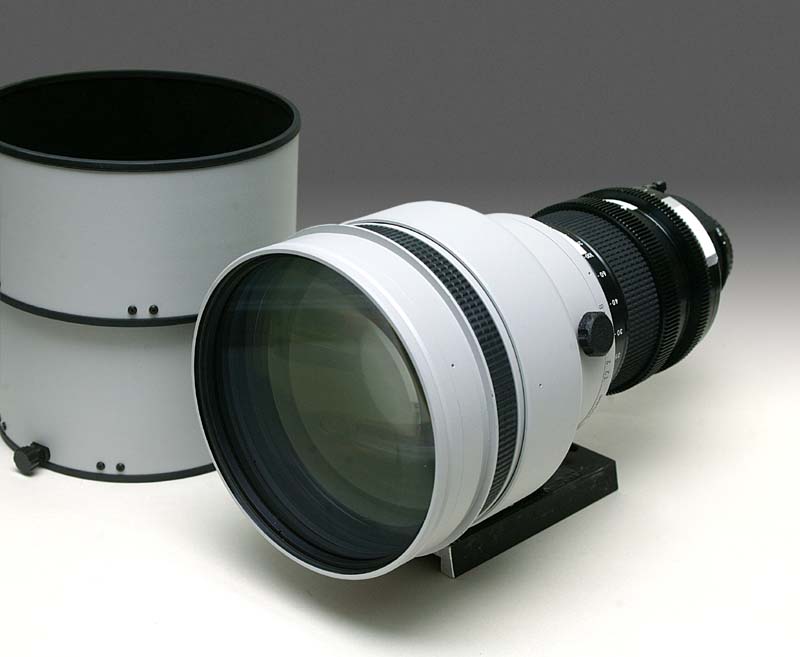
Canon's supertelephoto lenses have traditionally been white (cream) and the reason given was to prevent heat expansion affecting the optics. Other manufacturers predominantly make back superteles (actually Nikon once made a 300 f/2.0 that was white), as Tzarium points out in the comments this may be due to their not using flourite elements and thus have fewer issues with heat expansion.

A white Nikon lens!

In the end then it comes down to marketing. White is Canon's trademark — when you see a sea of white lenses at a sporting event you know the majority of shooters are using Canon and that's a fantastic advert for them!

Monday, July 18, 2011

What are good advanced books on the physics and science of photography?

Question

I am looking for books about the physics of DSLR, including modern photography optics and sensor electronics. If I already have some books on optics and electronics, I have found fairly hard to find good resource for these fields taking photography as a basis, with examples taken from photography and chapters dedicated to lenses optics for instance.

So far what I have found is either too generic, or, if dealing with photography, lacks the physical expertise I would like to get (I mean books with equations. Everybody loves them.)

Good books for physics of photography exist, but they are quite old, the last good I have found were written by Kingslake in the 70s and definitely miss the non-optical part, and the optical stuff is a bit old-fashioned now (but very nice books BTW).

To sum up, I would like:

  • Very technical references
  • Dealing with physical issues specific to DSLRs and modern photography, such as diffraction limits, image stabilization, properties of coatings, noise correction - whatever you can think of actually...

Answer

Books by Henry Horenstein are very technical, but are unfortunately more to do with film photography.

Thom Hogan (bythom.com) writes a lot of technical information about sensors. Well technical to most people, not a lot of equations. He references the book Manual of Photography by Ralph Jacobson - "the highly technical and math-filled volume that defines much of the state-of-the-art". Sounds like it might be what you're looking for.

What are good advanced book on the physics and science of photography?

Question

I am looking for books about the physics of DSLR, including modern photography optics and sensor electronics. If I already have some books on optics and electronics, I have found fairly hard to find good resource for these fields taking photography as a basis, with examples taken from photography and chapters dedicated to lenses optics for instance.

So far what I have found is either too generic, or, if dealing with photography, lacks the physical expertise I would like to get (I mean books with equations. Everybody loves them.)

Good books for physics of photography exist, but they are quite old, the last good I have found were written by Kingslake in the 70s and definitely miss the non-optical part, and the optical stuff is a bit old-fashioned now (but very nice books BTW).

To sum up, I would like:

  • Very technical references
  • Dealing with physical issues specific to DSLRs and modern photography, such as diffraction limits, image stabilization, properties of coatings, noise correction - whatever you can think of actually...

Answer

Books by Henry Horenstein are very technical, but are unfortunately more to do with film photography.

Thom Hogan (bythom.com) writes a lot of technical information about sensors. Well technical to most people, not a lot of equations. He references the book Manual of Photography by Ralph Jacobson - "the highly technical and math-filled volume that defines much of the state-of-the-art". Sounds like it might be what you're looking for.