Showing posts with label birds. Show all posts

Monday, May 7, 2012

What techniques should be used when attempting bird photography?

Question

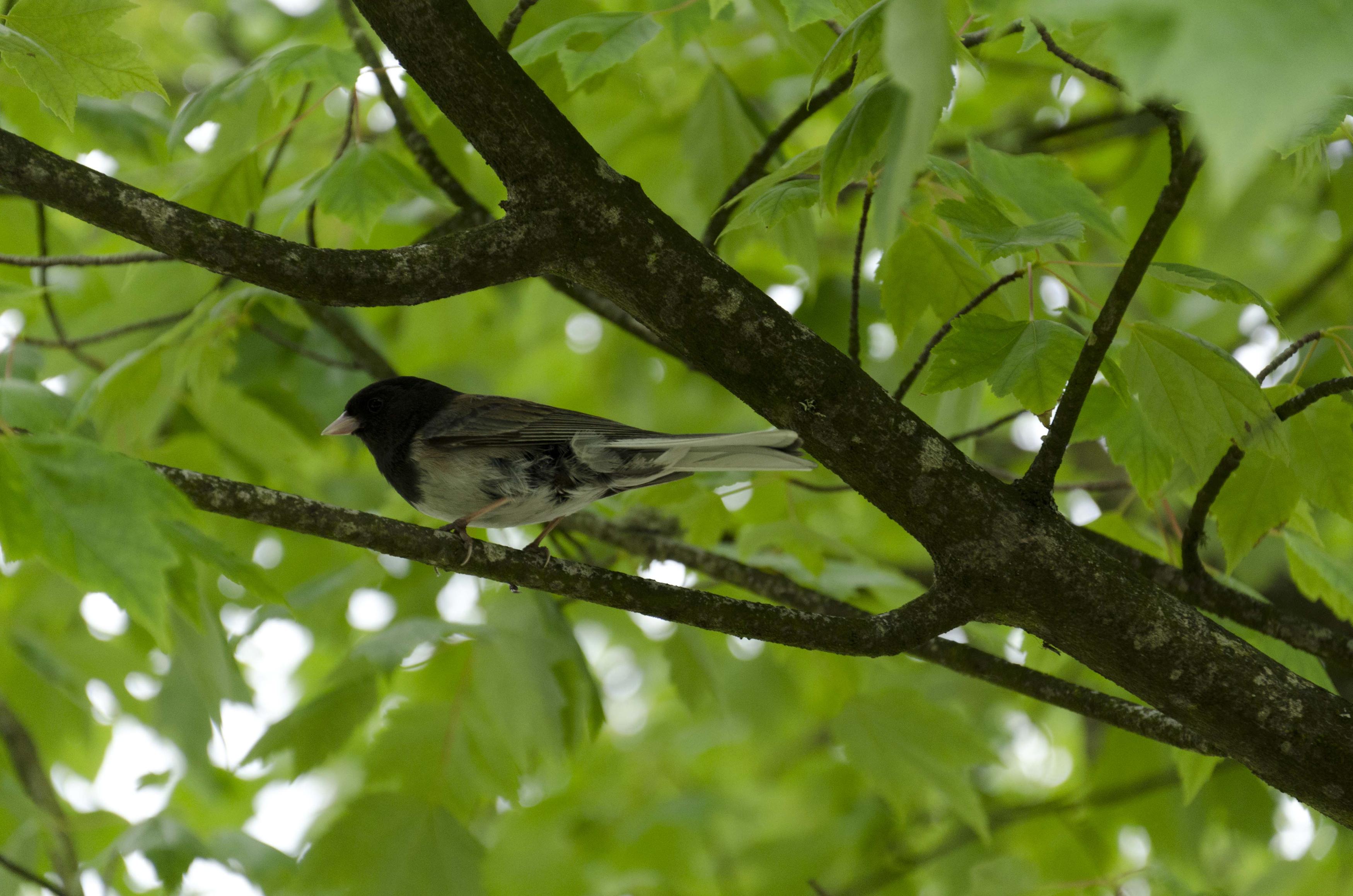
I'm pretty new, and was just playing with the D7000 kit taking pictures of birds in the area. I asked for my photo critiqued in Chat, led to some good general purpose information I think is applicable to all of these kinds of shots, not just my specific scenario.

I'm interested both in how one approaches the subject to make the shot, as well as general composition gotchas common for this kind of photography.

Here was the specific image in question (for ideas of things someone might do wrong): Example Bird Photograph
Asked by Billy ONeal

Answer

First off, birds are jittery little creatures, and much of the time need to become accustomed to you before they will let you get in close and capture one of those amazing, highly detailed, frame-filling shots. "Hanging around" for a while will give birds time to get used to you, realize your not a predator, and be less likely to fly off the moment you start to approach.

Second, it should be noted that even with a very long lens, such as a 500mm telephoto, you will still need to get fairly close to any bird, from your average smaller songbird to your larger birds of prey, to get a frame-filling shot. This means that many of your shots will need to be cropped to zero in on the main subject (the bird). Cameras with higher resolution are more useful here, as they allow more detail to be kept in smaller crops. Cropped sensor cameras (APS-C type sensors) will also help, as they tend to "extend the reach" of most lenses by their crop factor (for example, a 300mm lens on an APS-C sensor is "effectively" 480mm.) Lenses with image stabilization are also a huge help with bird photography, as using a tripod to capture birds (perching or in flight) is difficult at best, and impossible in any practical sense.

When you are actually ready to capture some photos, there are a few things to keep in mind. Perching birds, which are a lot easier to begin with than birds in flight, will usually fly right away if you approach them directly. Try not to zero in on a bird and walk straight for it...approach slower, and less directly, taking a zig-zag or winding path. Try not to be entirely silent, make some noise (but not a lot), and actuate your camera shutter a few times to get the bird used to the sound. Predators tend to approach silently, directly, and stealthily, and such an approach is a sure way to send a bird flying. Its also probably best not to look directly at the birds, at least not for long...let your gaze wander. You might also try bringing the camera to your eye by framing something else first, and pan over to the bird.

For your first few dozen bird shots, I would just try to capture the birds, and work on getting focus and camera shake under control. That is probably the first fundamental technique one should master when learning bird photography. Full-time manual focus can be very helpful here, as you can generally lock on focus with AF, and fine-tune focus manually before actually taking the shot (splitting your AF activation to another button besides the shutter button is also helpful here, as you can focus and take the shot with two different controls, and not always end up re-focusing every time you half-press the shutter button.) Once you have mastered focus and camera shake, you can start working on things like composition, depth of field (a blurry background is an excellent way to isolate a bird on a photograph), etc. You should also try looking for more interesting poses...a bird preening itself, nibbling at some seed, squawking at or fighting with rivals, capturing food, nurturing young, etc.

Answered by jrista

Sunday, April 22, 2012

Which Camera is better to take photo of wild birds?

Question

I am evaluating to buy one of the following cameras, that my friends have suggested to me:

  1. a second hand Nikon D5000 camera selling @ 1000 (plus a 55mm - 200mm Len)
  2. a first hand Nikon coolpix L310 selling @ 319
  3. a first hand Nikon coolpix L810 selling @ 399
  4. a first hand Canon 600D selling @ 1049 (kit lens)

From the website, I have noticed that the Nikon Coolpix L810 has a 26x factor (angle of view equivalent to that of 22.5-585 mm lens in 35mm [135] format) but I was wondering if it will be better than the Nikon D5000 200mm Lens?

My aim is to take photo of wild birds. Do let me know if there are questions.

Also, my friends say that the DSLR camera is much more harder to maintain but I don't want a camera that can take no quality photo: can you help me to assess this statement?

Asked by Jack

Answer

From a camera perspective the Nikon D5000 and Canon 600D are both perfectly usable and powerful enough for wildlife photography. However, neither one has a kit lens that would be useful for wildlife, especially birds.

As a very general rule of thumb, 300mm is the minimum for larger game, 400mm for larger birds, and you can never have enough focal length for the smaller birds. Often you'll find pros with a 600mm lens with a teleconverter to get even more length. With lenses of this length you have to start thinking of a good support structure like a good tripod with a good head.

However, there are good budget means to get adequate length for birding such as the Sigma 150-500 and 50-500 lens and the Tamron 200-500 lens. They are available for several camera manufacturers including Nikon and Canon. They give good performance for the price but they have limitations, too.

Another popular way of doing birding where you get a lot of length is with digiscoping. In this technique you use a spotting scope, which typically has more of a telescope like power, and add a camera to the end. Some rigs cost more than expensive lenses but with better focal length but some are more affordable.

Lastly, consider how much work you're willing to do for bird shots. You can get by with shorter lenses if you're willing to put in the work to use blinds and other techniques to get closer. The best birding pictures are those where the photographer has worked their way into a great position that doesn't interfere with the birds, is in good light, and a well chosen background. Also learning bird behavior is essential to good bird photography. The more you learn the more you can work around equipment limitations.

Answered by nwcs

Wednesday, February 15, 2012

Where can I find advice on using an advanced AF system for wildlife and bird photography?

Question

I recently purchased a Canon 7D, as my previous 450D had become a severely limiting factor in my endeavors to wildlife and bird photography (particularly bird photography, which I LOVE, but for which I have a bare handful of keepers out a few thousand shots.) The AF system of the 450D had a single cross-type point and a total of nine, while the 7D has a much more advanced 19 point system, all of which are cross-type. I've taken the 7D out a few times since I first purchased it, and while I have definitely had better luck photographing wildlife, I am still having trouble photographing birds on the move.

I have read through the 7D manual, however I am still not exactly sure where to start on learning how to use an advanced AF system in the real world for moving subjects. I could really use some insight from photographers who regularly use advanced AF systems for tracking subjects and keeping them in focus. I would also like to know how to take multiple shots of a subject on the move and keep them in focus between shots. While I can often nail one shot in a motion sequence, I regularly seem to fail to get proceeding or trailing shots after the one keeper (and that keeper is often not the most interesting one of the bunch.) The 7D supports a variety of AF modes as well, including AF Expansion and Zone AF, where the camera can supposedly utilize extra points around the selected point in case the subject moves away from the selected points area of sensitivity, or the selected point lands on a low-contrast part of the subject and a neighboring point lands on an area of high contrast (so focus can always be achieved, even if the selected point isn't detecting anything to focus on.) I have also not had much luck using either of these modes, and I think its primarily because I simply don't know how.

From a lens standpoint, I have used the following lenses:

  • EF 100-400mm f/4.5-5.6 L
  • EF 100mm f/2.8 Macro
  • EF 50mm f/1.4

My most frequently used lens is the 100-400, usually at the 400 end, so aperture is only f/5.6. I am not sure if that might be a problem or not (as far as I understand, the 7D supports AF at f/5.6, although I am not sure how many points might be considered "high precision" at that aperture.)

Asked by jrista

Answer

There are several custom function options available to the 7D which can be configured to assist with tracking moving objects:

  • C.FnIII -1 AI Servo Tracking Sensitivity You want this set to "Slow" - this will stop the AF system trying to refocus on anything that briefly passes between you and the subject you are tracking - handy with birds where branches etc might flash by as you track

  • C.FnIII -2 AI Servo 1st/2nd Image Priority This should be set to 0 so that the camera will give priority to focusing on the subject over taking shots - basically, if it thinks it hasn't got a lock, it won't shoot while it obtains one

  • C.FnIII -3 AI Servo AF Tracking Method Set this to 1 - this further adds to the system ignoring obstacles by allowing the system to use AF points around the main focus point when something gets in the way of what you were tracking

Use single point AF with the AF Expansion custom function (C.FnIII -6) switched on - this gives you accuracy on the initial pick up but then allows the camera to help out as you track.

These settings should be correct from the camera side of things but the story doesn't end here.

Your 100-400mm L lens has a 2 mode IS system, with more predictable objects, you should use mode 2.

For tracking moving subjects it is important to get a good solid stance and to track the subject as it approaches some time before you want to start shooting (trickier with birds but achievable depending on the behaviour of the species). You should also follow through after you shoot (much like when shooting a shotgun).

You need your feet about shoulder width apart and need to be facing across the path of travel of the object you're tracking:

Object -------------------------------------------->

               ^ 
              You 

Hold the camera with your right hand as normal and with your hand a good way down the lens (similar to holding a rifle or shotgun). Keep your elbows tucked in, possibly resting against your torso to provide extra support and twist your torso from the hips upwards to meet what you want to track. Track it in the viewfinder, ideally if you can switch eyes so if you're tracking right to left, look through the viewfinder with your left eye so you can keep your right eye open to help keep track of the object (especially if it moves erratically) - do the opposite for left to right.

Start tracking the object, and smoothly pan with it. If you are shooting birds, turning off IS altogether is probably a good idea as the movement is likely to be too erratic for the IS to keep up with (even in panning mode 2) - aircraft are steady enough to use IS mode 2 with usually.

Squeeze the shutter release, don't press it (just like with a rifle) or it will jolt the camera and try to keep the object in the viewfinder as you get glances between shutter releases. Carry on tracking as the object moves away.

Getting a smooth torso twist is paramount and takes practice but getting the stance right gives you the foundations to build upon.

Answered by JamWheel

Friday, December 30, 2011

Nikon non-VR 70-300 lens for entry-level bird photographer?

Question

I am an entry level photographer who'd like to start taking pictures of birds.

I have a Nikon D40 and am on a budget.

I noticed on the B&H site that the non-VR Nikon 70-300mm lenses are around $150 or so.

Is this worth considering? I have trouble with camera shake even with the kit lens, although I do have a tripod.

Is there another lens I should evaluate, or a lens/extension tube combo?

thanks.

Answer

I had the 70-300mm non-VR lens, and it was poor. A very cheap build, and very soft at 300mm. I took sample pictures on a tripod at 300mm, and compared them to my 80-200mm at 200mm, and decided it was almost better to shoot with the 200mm and crop (in other words, cropping the 200mm shot so the subject was the same size as the 300mm shot, the 200mm was about the same sharpness).

The lens autofocuses very slowly due to the minimum aperture, especially at 300mm (f/5.6).

The Nikon 80-200mm f/2.8 is a good choice if you want to try a used lens, as they are built like tanks. Could add a 1.6x teleconverter. The 80-200mm is a good lens for sports (fast AF) and portraits (nice bokeh) too. There are AF-D and AF-S versions, you'll need the AF-s on your D40.

The Sigma 150-500mm is a good lens. It's also slow, but has OS (VR) and a lot of reach. You can hand hold it at 500mm in good light. It is an HSM lens so will AF on your D40.

The Nikon 70-300mm VR is a great lens. It's completely different than its non-VR brother. It's AF-S so will AF with your D40.

Sunday, July 17, 2011

What are the best spots around Louisville, KY to shoot wildlife?

Question

Just as the title says, does anyone know any good wildlife spots around Louisville, KY? I am interested in birds, small critters, but also larger animals.

Answer

I love going to Papa John's Park over off of Bluegrass Parkway. If you're able to travel and getting up early, you can go to Birnhim just south of Louisville near bardstown. They have some awesome woods and trees.

May sound silly, but when I got into photography several years ago, I got a season pass to the Louisville Zoo and had some awesome learning experience and amazing photos.

Just across the bridge, you can check out Falls of the Ohio and get some awesome water shots.

Over by riverfront, there's a water park that has sprinklers that makes for neat photos.

If you have a dog and member of a Louisville Dog park, you can go and get some cool pictures of dogs running.

Friday, July 15, 2011

Is digiscoping a good alternative to using a super-telephoto lens for birding?

Question

While I was researching bird photography, I noticed some people suggest using a spotting scope in front of digital camera instead of a super-telephoto lens - this technique is called digiscoping.

So far, I've understood there are such major differences when compared to using a super-telephoto (400+ mm) lens:

  • a much longer focal length (1200+ mm);
  • lower price;
  • smaller weight;
  • manual focusing only;
  • zoom option when shooting through zoom eyepiece;
  • smaller maximum aperture (f/8 seems to be common);
  • support (e.g. tripod) is a must, which makes the equipment less maneuverable;
  • need equipment for attaching and/or adapting the camera to spotting scope;
  • some spotting scopes come with angled ocular - good for minimizing neck fatigue, but makes hard to follow action.

Are there any other important factors to bear in mind when deciding which way to go about birding?

I am aware of the option to get the birds closer with bait, but this question is more about photos in action other than gathering food (in air, on nest), so I'm afraid a short focal length will not do.

Answer

spotting scopes can be useful and you can get publication-caliber images from them with practice (just check the birdwatching magazines). The downside is the lenses are relatively slow (F8 or slower) so they are useful in good lighting conditions but not nearly as good in marginal conditions. They are manual focus, and setup/use can be cumbersome and doing it well can require practice. The manual focus and slow speed mean they are useful primarily for stationary or mostly stationary birds. Since most birds aren't stationary most of the time, you are going to be trading off time setting up for a shot and being patient for the bird to step into the frame against a more flexible lens that might lend itself more to catching the bird in action.

The images are going to be softer, too. The lens quality just isn't up to the top end lenses, although on the higher end the quality is quite good.

So, cheaper, but slower, less flexible, and softer. And sometimes, it's the only way to get the magnification needed to get a shot without winning the lottery and hiring a forklift... it's a viable option, but realize that if you research the guys getting published using scopes, their rigs are probably closer to $3,000 US than $1,000. I don't think I've seen a scope i'd consider capable of publication quality images for under $1,000 US, although if everyhing goes just right, you might get one here and there. But predictably?

Tuesday, July 12, 2011

How can I photograph hummingbirds?

Question

The rules for photographing normal birds largely don't apply to hummingbirds. You're unlikely to be able to predict or keep up with their flight path, especially with autofocus. Additionally, the wings move so fast that traditional shutters only capture them well at max speed with bright light.

What are some techniques to overcome the focus and wing-freeze issues?

Answer

Disclaimer: This is second hand information, so YMMV.

While I was guiding a tour in Ecuador, I met a photographer who spent almost 10 years chasing hummingbirds for a book. We spent an hour or so talking about how to photograph them. Here are the basics:

  • They are too fast to freeze with a high-speed shutter.
  • Use flash with an ultra-fast discharge speed. He said around 1/20,000s.
  • He said using the flash on lower power increases the discharge speed.
  • Shoot continuously as fast as possible.
  • Manual focus on where you want them to be. Usually an interesting flower or branch.
  • They can be moved by hand while in their sleeping state. They are very delicate, avoid nets to catch them.
  • Move them to a tent with a sweet flower as bait and studio lighting setup. Take a few shots and let them go. They need to eat every few minutes apparently.
  • Learn about the flowers they like to know where they'll be and how to bait them.