Showing posts with label accessories. Show all posts

Wednesday, May 9, 2012

Any good ways to keep a DSLR with a heavy lens parallel to your body while carrying?

Question

I have a D80 with a fairly large lens which weighs the camera down and whenever i am hiking/walking long distances it gets annoying because it isn't parallel to my body. Are there any solutions? Like special holsters/belts to keep the camera parallel to my body? Or at least more secure in some fashion? I don't like it bouncing on my chest gives me a rash and the camera gets worn out form constant friction.

Asked by antonpug

Answer

Check out the Cotton Carrier vest, which holds the camera vertically tight against your chest. I haven't used it myself, but do know others who are happy with it.

Answered by Dan Wolfgang

Friday, February 24, 2012

How do I get shaped bokeh without a Lensbaby?

Question

Is there a good hardware solution for generating shaped bokeh? I know Lensbaby has a set of filters that give various shapes — is there a similar solution for other lens?

Asked by beggs

Answer

Bokeh Masters Kit

Available here: http://www.bokehmasterskit.com/

Answered by AJ Finch

Thursday, February 23, 2012

How to more easily view the rear LCD?

Question

I was at work today and went for lunch, there was a professional photographer in kitchen using the following set up

Canon 5d tripod Canon tilt shift lens (not sure on the specifics)

The photographers was using live view to take his shots and kept placing a eye piece over the lcd live view finder. What is this peripheral called and where can I get one?

Thanks!

Asked by David

Answer

Those are LCD viewfinders. You can find a huge variety of prices and shapes, but they're all basically just a box to block light and make it easier for you to see the LCD screen without any reflections getting in the way.

Answered by Dan Wolfgang

Friday, February 17, 2012

What are some good places to get equipment reviews online?

Question

When making gear purchases, it seems sensible to get as much information as possible.

Where are good (i.e. reliably accurate and informative) places to look online for equipment reviews and discussions?


Answers here should focus on reviews and comparisons covering equipment other than camera bodies and lenses, because those are already covered under these questions:


This is a "community wiki" post, where answers do not have individual ownership. Please post one suggestion per answer, and use the answers to rate and comment on each site.

Asked by n/a

Answer

B&H Photo Video is not only a great source to buy equipment, but it is a great source of reviews and relevant information about the equipment. I usually just find the category I want, and sort by the "Top Rated" or "Relevance" and typically that will direct you right to the most popular model.

enter image description here

Amazon also has many reviews and has a great system for showing you the most popular and highest reviewed models in each category. Overall I've found the reviews on Amazon to become somewhat dated. If a product has been available for a few years, many times the most popular reviews are from day 1. So they may be lacking up to date comparisons. But if you are aware of this, and look beyond the top rated reviews, many times you will find relevant information.

enter image description here

Personally I enjoy landscape and nature photography, so I like to browse the equipment section of the most recent Outdoor Photography magazine that I receive. I've found that if you are really aware of the market, some of the "new equipment" actually has been out for quite a while and the magazine editors just finally picked up on it. But if you aren't worried about being on the cutting edge(which isn't necessary) then this might turn you on to some new gift ideas or things you didn't even realize you needed.

Answered by n/a

Will a LensCoat BodyGuard CB fit a Canon EOS 1000D?

Question

I'd like to buy a LensCoat BodyGuard for my Canon EOS 1000D.

I'm in doubt because my model isn't listed in that page, so I wonder if it fits it or no. Any experience?

Then, I live in Italy, so I can't buy it anyway on amazon.com because it gets too expensive. Do you know any other good online shop for such things?

Thanks

Asked by Carlo

Answer

Looks like you want a BodyGuard Compact.

Answered by Dan Wolfgang

Thursday, December 22, 2011

Can a Wireless Shutter Release control camera movement, exposure or metering?

Question

So, I looked up this: http://www.nikonusa.com/Nikon-Products/Product/Remote-Cords/4730/ML-L3-Wireless-Remote-Control-%28Infrared%29.html

Questions:

  1. Does a remote move the camera's face? I mean, if I have a movable LCD monitor on the DSLR and I am far away, will I be able to adjust the composition of the scene through remote only?
  2. Do the remotes control:
    a. Shutter speed?
    b. Aperture?
    c. ISO?
    d. Metering?

Is there anything that a remote can NOT control in a DSLR?

Answer

None of the above, I'm afraid. The Nikon remote is essentially an infrared (wireless) version of a cable release. Just about all it does is half-press and fully-press the shutter button remotely.

You can get a lot of camera control using Nikon Camera Control Pro software with the camera connected to a computer via USB and set to Live View mode. That will let you change a lot of the settings as well as choose an area to focus on. The autofocus is contrast-detection rather than phase-detection in Live View, though, so it's a little on the slow side. (The included software is the big let-down for Nikon owners -- all of the good stuff requires extra-cost programs like Camera Control Pro and Capture NX2. Other makers include those features with their cameras.)

As for actually moving the camera around, you would need a remote-controlled camera mount. They vary between simple wired motorized units with a huge and crude-looking control box with three or four switches and sophisticated servo-controlled units, and they're not particularly inexpensive. (The cheap units used for miniature surveillance video cameras aren't up to the task of dealing with a DSLR.) It's very specialised equipment, and most people who need a system like that only need it for the occasional shoot, so it's usually a rental item at well-stocked pro dealers.

Wednesday, December 21, 2011

What kind of tape to use when mounting photo to mat?

Question

I'm looking to print, mount, and frame a bunch of photos I've taken. I've normally used poster-style frames (borderless and with no mat), but I'm beginning to develop an aesthetic preference for matted photos. I recall hearing at some point that there's a special sort of tape one should use when mounting the photo to a mat board, but I can't remember what it was. Is it a special acid-free tape so it doesn't eat away at the picture over time?

What should I look for in tape or other adhesive for the purpose of mounting a photo to a mat board? Is there a particular brand that is more revered than others?

Answer

I use Lineco Self Adhesive Mounting Strips. The advantage of these is that the photo is not mounted physically at all to the mat. This takes into account the different rates of expansion (due to humidity changes) that the photo and the mat have, the photo will never buckle since it floats on the back of the mat.

Plus it is super easy and cheap also!

Monday, December 12, 2011

What to buy first after getting the first DSLR?

Question

I got my first DSLR (Canon 600D) with the 18-55 EF-S lens, now I'm considering to go a further step and buy stuff for my gear but I really can't decide what to buy first. There are a lot of choices but I think that some are more important than others. For example, I believe that the cleaning accessories with a decent tripod and a head are more important than an extra lens, also a prime lens would be nice, lens accessories like hood, filters, converters too. And an external flash is good to have too. But I'm confused what should I pick first. What is the most important things to buy after getting a dslr.

I'm interested in all photography categories except maybe sports

Answer

I suggest you should observe how limitations of your existing gear keep you from getting photos that you want, and make your purchase decisions based on that. It's very personal, so there's no single roadmap that applies to everybody. But they key to avoid wasting money is: whenever you're going to purchase something, have at least couple of images in mind that you want to take, and some vision on how you could use that in future.

There's one basic accessory that can be useful to almost any camera owner - a battery that dies in the middle of a shoot could mean no more photos that night, so you might want to have a spare one in case that happens.

You don't mention any limitations in your question, so it might very well be that all you need to do now is use your gear to get to know where you'd need something extra.

Friday, November 25, 2011

Which suits better for hobby usage: extension tubes vs. close-up filter?

Question

I am looking to do a little macro work, but am not ready to invest in a macro lens. For hobby work like photographing flowers and such would it be better to invest in a set of extension tubes or in a good close up filter? I would like to utilize my Canon 40D with either the 24-70mm f/2.8L or the 50mm f/1.2L lens I already own.

Answer

I've used extension tubes in the past, with success, but what I did find was that you'll have to manual focus because the AF sensor gets really crazy with tubes. For most macro work you'll want to focus manually anyway, so use your camera's live view.

I would stay away from close up filters. They're bulky and the quality is very poor.

In general, if you don't already own a portrait lens, a macro lens with a short focal length (say, the EF-s 60 or EF 100 macro lenses) can double portrait lenses.

Monday, November 21, 2011

What are most important accessories for indoor portraiture?

Question

I am brand new to DSLRs, so please bear with me. We just bought a Nikon D3100. Christmas is coming up; what are going to be the most critical "starter" accessories? Most of our shooting is indoor, portrait-esque shooting. I have asked for everything I could think of on my wish list, but I didn't know how to prioritize. Here's a short list:

  • DSLR backback/laptop case (so we only have 1 carry-on for the airlines)
  • Eye-fi sd cards (because they just look cool!)
  • A directable flash
  • A 55-300mm zoom
  • Tripod
  • Extra Batteries
  • Lens Cleaning and maintenance stuff...

Anything I missed?

Like I said, we're brand new to DSLR and I just want to know what's going to help me most right out of the gate. What are the most important two or three things?

I recognize that to answer this question for "me", I'd need to give a lot more details... I want to know from your perspective what you'd ask for.

Answer

Some suggestions and comments, in no particular order of importance.

Lenses

For indoor shooting, a 55-300mm lens will do you close to no good, unless you have an amazingly large indoor area. You'll only be able to use the shortest focal length end (around 55mm), where the quality is most likely the worst. For most of my indoor shooting I use a 35mm prime lens (on a crop sensor like yours). For portraits, 50mm and up is often considered better, when you have the room. I do often use a 70-300mm lens for portraits, but almost always outdoors, where I can get very far away from my subject.

For more general indoor shooting, I would recommend something in the 35mm range, although if you want a zoom lens, maybe something in the 15-70mm range (most Canon stock lenses are 18-55mm, which is great for most indoor shooting).

For a lot of indoor shooting, a very fast lens is also useful, because you're often in poorly lit environments. If you're setting up portraits, though, you'll likely have a lot of control over the lighting, so a fast lens may not be as important.

When I'm shooting at parties, family gatherings, etc, I love the f/1.4 speed of my 50mm prime lens, and the f/2.0 on my 35mm lens. This is the main thing that makes my DSLR outshine all my friends' point-and-shoot cameras.

Lighting

If you're "serious" about portraits, then a directional flash is not nearly as important as off-camera lighting. The cheapest off-camera lighting for indoor portraiture is going to be halogen "work lamps"--the kind you buy at a home improvement store (Home Depot, Lowe's, etc). The problem with this type of lighting is that it puts off a lot of heat, meaning your subject (and maybe you) will be sweating after just a few minutes. You can help this a bit (and the picture quality) by bouncing the light off a neutral-colored wall (meaning white or grey--not blue or pink or yellow, etc), so the light isn't shining directly on your subject. They'll still put off a lot of heat, though, so you'll want to turn these lights off between shots, while arranging your props, etc.

The next best option is to get one or two off-camera flashes. If you already have a directional external flash, it can likely operate as an off-camera flash if you get the right transmitter for your camera. Some newer models (at least in Canon's line up) have built-in flash transmitters. My Canon T3i has one, and I love it. I use it all the time! You an also buy flash transmitters that attach to your camera as your flash does. They can be a bit expensive (US$250 range I believe). And your best results will generally be with two (or sometimes more) off-camera flashes. Just one can work if you like low-key portraiture (which can be a lot of fun).

Tripod

You probably won't ever need a tripod for indoor portraits. You generally need a tripod for low-light/long-exposure situations. People move too much (even when sitting "perfectly still") to use a tripod to shoot them for these reasons. You might use a tripod, along with a remote trigger (wireless or wired) to buy some hands-off abilities. This is most useful when you're dealing with children, and trying to get them to laugh or smile, and need to have your finger on the camera trigger at all times to capture the right moment. It can also be useful when you're forced to hold a reflector or prop and don't have an assistant to help you.

Backdrops

I recommend buying some bed sheets! King Size is best, and just the flat ones. I often pick them up at Wal-Mart for about $10-15 each. Get a variety of colors. If you're creative, tie-dye some, or spray paint them, or throw them in the mud, or whatever, to add extra color/textures. Then use them as backdrops for your portraits. It's also good to have one or two plain white ones that you can use to drape over the back of a chair, or hang on the wall to bounce your lights off of, for less direct/harsh lighting.

Hair clips

Especially if you're ever shooting women, it's good to have some hair clips, to hold back unruly bits of hair. Get a variety of colors, so you're more likely to have one that will match your subject's hair color.

Other props

Stuffed animals, big hats, umbrellas, floor lamps... anything creative that can add to the mood of your pictures. Keep an eye open at garage sales, auctions, thrift shops, for those special funny and odd props. Your new photography hobby is always a nice excuse to buy a giant banana... or whatever else might catch your eye.

Wednesday, October 19, 2011

Can I use old camera accessories with a new DSLR camera?

Question

I found a good price on a Rebel X. It comes with a flash and a couple lenses. Could I use those accessories with most new DSLR cameras? Would I be limited to Canon cameras?

Answer

Rebel X (EOS-500/Kiss XS without pop-up flash) is a fairly recent entry level body. It uses EF lens mount, so the lenses should work fine with current Canon DSLRs. The flash hot-shoe is also compatible with current models, although Rebel X did not support E-TTL. The flash will work on a Canon dSLR, but the features it will offer depend on the flash and cannot be determined from model number of the body. Any EX-series flash can be used with E-TTL metering.

The lenses can be used on Canons, and any other camera system (e.g. micro four thirds) that has adapters for Canon EF lenses (with limitations imposed by the adapter). The flash can be used in manual mode with any modern dSLR (except Sony/Minolta); advanced features, if there are any, can only be used on a Canon.

Friday, October 14, 2011

Has anyone any experience of the Flipbac Camera Grips?

Question

I was looking at Flipbac Grips for my Canon S90. Was wondering if anyone had any comments to share about them. Yes I'd prefer Richard Franeic's custom-machined aluminium version but I'm too miserly. Will the G1 or G2 do the job at least competently?

Thanks.

Answer

I have used both the Flipbac Grip 2 and the RF grip (on my previous S90). The RF grip is nice but the Flipbac Grip is no compromise. I feel it is much better value for money. It fit my S95 perfectly. On a recent weekend trip with my wife it was invaluable. Easy one hand holding. It feels good and looks good. I don't own my camera long enough to justify the $45 on the RF grip.No regrets.

s95 shooter Western Australia

Sunday, October 2, 2011

How to choose a gaffer's tape?

Question

After a long time using my flash with rubber bands to hold flash accessories, I decided to try the Gaffer's tape method recommended by many photogs. So, I searched for that on B&H's website and got multiple results. Some of the results explicitly mention no residue and some don't.

In the past I bought a "painter's tape" at Home Depot that supposedly leaves no residue as well, but this feature is limited to 14-days of contact.

So, any particular suggestion for a cheap non-residue gaffer's tape? Something that will tear off a year from now without leftover? I just need ~30cm, so spending $8-$10 on a full roll already seems excessive, so I'm more inclined to the cheap side...

Answer

For my flash I use the wide rubber band with Velcro on it approach to hold stuff in place. Something like this... (argh, hopeless URL; just google for the term "flash velcro rubber band" without quotes, the first one is a reference to a page with a Gary Fong whaletail setup which is the page I mean) It works well enough for me, though I haven't used it for anything heavy. Some quick googling did not look promising for you; "Despite the claims they make about gaffer tape it will not stick very well in the cold and if you leave it on too long it will leave residue behind".

Thursday, September 22, 2011

What's the best way to avoid wasting money on equipment? [closed]

Question

Budgets usually have tighter limits than wish lists. What strategies can be used to avoid wasting money on equipment?

By "wasting", I mean spending on an expensive item of photography equipment to solve a problem and then finding it frequently fail at solving well the problem it was supposed to tackle. The inability should be attributable to the product's design, not breakage of a specific item or inexperience with such gear.


I felt a recently closed question about useless accessories had some potential for taming the widely spread constant need for new equipment and bringing out some marketing hype, so I'll try to ask a similar question in a more constructive way.

Answer

I don't have a personal tale of great gear disappointment, but I offer some general advice.

Be clear what problem you are trying to solve

Are you buying a new body in order to become a better photographer? That's probably not going to happen. On the other hand, buying a new body to get improved noise at high ISOs may well work out nicely for you.

Reviews

The internets are full of reviews, even for pretty esoteric bits of kit. Find a review of the specific item you're considering. 10 minutes doing this might save you from disappointment.

(Update inspired by @jwenting and @imre - see comments):
Consider how credible reviews are. Finding several reviews on different websites may help to work out which are reliable. Amazon is a good place for reviews because you can often get several opinions together.

eBay is a Gamble

Buying second-hand is a great way to save money, but sometimes it will backfire on you. It's just the law of averages. If you accept that it's a gamble, then you can save some heartache.

... Just a few thoughts.

Wednesday, August 24, 2011

Manual photography cheat sheet — where can I find one, or what should be on it?

Question

I have been trying to shoot more in manual modes (both camera and flash). At this point, I understand all the concepts, but all the adjustments slow me down.

I'd like to have a "cheat sheet" with all the basic calculations/tables on it that I can refer to in order to speed up the process, in a format that I can easily keep in my camera bag.

Does anyone know of a good sheet, or alternatively, if I create it what information should I include?

At the moment I'd like to have at least:

  • an f-stop list (just full stops)
  • basic guide number information

Answer

Since there are 3 important variables here: aperture, shutter speed and ISO, I would Google for Exposure Triangle Cheat Sheet for example. Here are a few:

I see you updated your question. With respect to guide numbers here is one:

Thursday, July 14, 2011

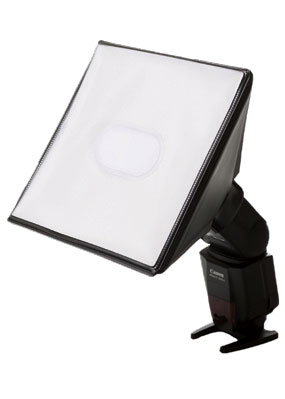
Are small on-flash softboxes useful, or a gimmick?

Question

There are a number of "mini-softbox" products on the market. These are meant to mount on a hotshoe flash (usually with an elastic band).

fair-use small image from lumiquest
Lumiquest Softbox III


Are these worthwhile portable and low-space light modifiers, or are they more gimmick than useful? Are they large enough to meaningfully diffuse light for portraits? Are they too close to the flash?

Are any particular designs better than others?

Answer

I have the Lumiquest Softbox III that's mentioned, and I find it useful as a super-portable softbox that's better than nothing. Given the option to have a huge softbox that would be my first choice, but the small softbox, placed very close to a subject, works really well and provides a much softer directional light than one would get with a bare flash or with just a simple diffuser such as an Omni-Bounce.