Showing posts with label high-iso. Show all posts

Sunday, May 20, 2012

Why does Nikon warn about banding at high ISOs when using autofocus on Nikon D4 or D800?

Question

Nikon says that banding may occur at high ISO sensitivities with autofocus on the D4 or D800:

D800

Noise in the form of horizontal lines may appear in pictures taken with AF-S Zoom Nikkor 24-85 mm f/3.5-4.5G (IF) lenses at ISO sensitivities over 6400; use manual focus or focus lock.

D4

Noise in the form of lines may appear during autofocus at high ISO sensitivities. Use manual focus or focus lock. Lines may also appear at high ISO sensitivities when aperture is adjusted during movie recording or live view photography.

What would explain this behavior?

Asked by DragonLord

Answer

This problem is caused by electromagnetic interference generated by the SWM in many Nikon lenses.

There are cases where Canon lenses with USMs have caused banding. See this dpreview forum thread for an instance of sensor banding caused by a USM lens mounted on a Canon DSLR.

Answered by DragonLord

Tuesday, July 12, 2011

Is high ISO useful for photography?

Question

I started photography sometime back, and always wondered when is high ISO handy in photography? Also can it be used to get any special effect in pictures?

My camera has Max ISO of 800 but I see some camera which boast of 64,000 etc. Does it really affect the performance?

Answer

ISO is very useful as it helps overcome read noise by amplifying a weak analogue signal prior to digitization (which adds a more or less constant amount of noise) thus giving a better signal to noise ratio.

That's all raising the ISO does, amplify the signal. It does not make the picture noisier because it only amplifies what's already there.

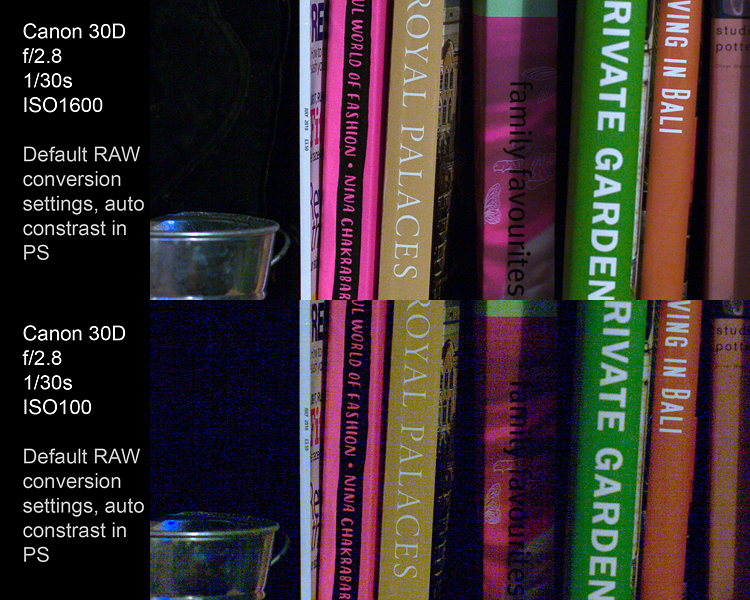
See this example. The ISO100 shot was significantly underexposed and suffers from really bad read noise. The same amount of light enters the camera in the second shot, but due to ISO the signal is amplified before readout, thus read noise is a smaller percentage of the signal and overall signal to noise ratio is better:

To using a high ISO actually helps to reduce noise when you have a limited amount of light (and you can't get any more by opening the aperture or shutter for longer).