Question
A friend has been kind enough to lend me a DSLR for a few months. It's my first foray into DSLR photography, or indeed any kind of photography beyond simply aiming my Canon IXUS at something and clicking the button.
Over the last few weeks, I've been busy studying, practising and trying to learn as much as possible ahead of a planned trip to Norway where I hope to see, and get some photos of, the Aurora Borealis.
I currently have:
- Canon Rebel Xsi (450D)
- Canon 50mm f/1.4 L
- Canon 18-55m kit lens
- Aluminium full height tripod with ball head
- Cable release
- Spare battery & memory cards
I'm prepared to spend the night wrapped up outdoors, in the hope that they will make an appearance. I'd like some advice on how to get the most out of this kit for the trip:
How should I go about setting up to get pics of the Aurora?
How might I achieve optimum focus?
From what I've read, I'll need to use the tripod and cable release, with IS turned off, on continuous shooting mode with long exposure times. But I'd like some more specific tips in terms of which aperture and ISO settings might work best?
Should I use one of the lenses above, or would it be worthwhile renting a better, wide angle lens; if so, which would you recommend?
Answer
I've never attempted to photograph the Aurora Borealis myself however the following advice applies to most celestial photography:
You will want the fastest (biggest aperture) lens you can get your hands on. The 50 f/1.4 is ideal, though the focal length is quite long for this sort of thing. It's good because it will let in about 5-6 times as much light as the kit lens! Fast wide lenses are a rarity for crop camera bodies such as the 450D. If you need to go wide you might get away with a Sigma 20 f/1.8, the other alternatives are not cheap: the Canon 16-35 f/2.8L would be better than your kit lens, but I'd personally go for the 24 f/1.4L even though it's not as wide.
In terms of focussing, for the lights themselves you'll probably want the lens set to infinity (i.e. as far as the focus ring will go) or occasionally just short of infinity. Given that the lights are very far away (i.e. the upper atmosphere) your depth of field at this focussing distance will be huge. If you want to get some foreground in for scale / composition, then obviously you need to set focus for that distance from what I can tell the Aurora are kind of fuzzy anyway to it wont matter too much if you have to focus closer. AF probably wont work in that sort of light so you focus by trial and error or maybe use live view to focus.
Shutter speed is a compromise between letting more light in to minimise noise, and avoiding motion in the images. I don't know how fast the Aurora move but this will probably limit your shutter speed. Noise can also increase with shutter time due to the sensor heating up however this might not be a problem where you're going! Multiple short exposures are generally better than one long one.
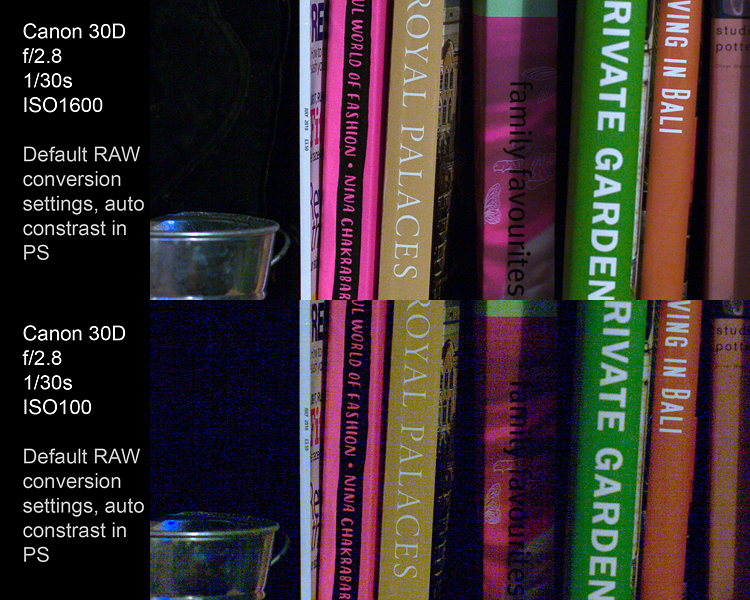
To reduce noise you need to get as much light down the lens as possible, and then set the ISO as high as possible (without overexposing). This sounds counter intuitive so I'll explain a bit more. High ISOs don't cause noise and actually exist to reduce noise. Noise comes from the sensor electronics, but also from the random nature of light itself. So it's not high ISOs that cause noise, it's low levels of light. The confusion originates from the fact that using a high ISO in auto mode will allow a faster shutter speed and result in more noise, however the noise is a result of a fast shutter letting in less light. If you're already letting in as much light as possible, then lowering the ISO will reduce the amplification on the sensor, and when the values are read out they will be lower and thus the readout noise will be higher in proportion. When you correct the exposure in post you amplify this readout noise. When you use a high ISO, the analogue signal is amplified before readout occurs so you don't end up amplifying the readout noise. If you still need convincing, check out this example of an underexposed ISO100 is far noisier than a correctly exposed ISO1600 shot. For the settings used, increasing the ISO, even to 1600, decreased the noise: http://www.mattgrum.com/ISOcomparison/ISO_100_vs_ISO_1600.jpg
Generally when working at night stacking is the way to go. This means shooting many shorter exposures and then combining them on your PC to produce a single image. There are many pieces of software that will do this for you, Deep Sky Stacker is one of the best. The software is designed to cope with the movement of the stars, it may be able to cope with the aurora moving as well, or you might get some ghosting.
Other things to bear in mind are that cold dramatically reduces battery life, so keep one battery in an inside pocket close to your body and swap them often. This probably wont affect you but if you're shooting exposures around 1/2s you should use the mirror lockup function to avoid the mirror slap causing vibrations which can show up in the image.
I would also recommend searching flickr for photos of the Aurora, most of the images will have the EXIF information still attached so you can see what camera settings / lenses other people are using.
Good luck!
Check more discussion of this question.