Question
I have a Canon 7D with a 50mm f/1.4 lens, and I think the auto-focus of the lens is off. How can I test and adjust this reliably?
Will this approach work with all of my lenses? If I had a different camera body, would I have other/different options?
Answer
Moire Fringe Method
Use Bart van der Wolf's moire fringe method (also explained here and here, and archived here):
It works by exploiting the
interference patterns or moiré between
the R/G/B LCD elements and the
camera's LCD elements when directly
viewed with Life View [sic]. With good
optics and perfect focus, the moiré is
maximized.
Compared to focus charts
Pros:
- Much more precise.
- Unaffected by tungsten / incandescent lighting, which causes front focus. (I'm not positive if extreme monitor color temperatures affect it.)
- Easier to line up 100% perpendicular, yet less affected by it.
- Doesn't require taking a picture: liveview is sufficient with magnification.
Cons:
- Without liveview, I'd imagine it'd be tedious.
- Can't calibrate for tungsten lighting. (Though you can use a focus chart to supplement, and estimate the offset you'd need to give it for tungsten)
The Target Pattern
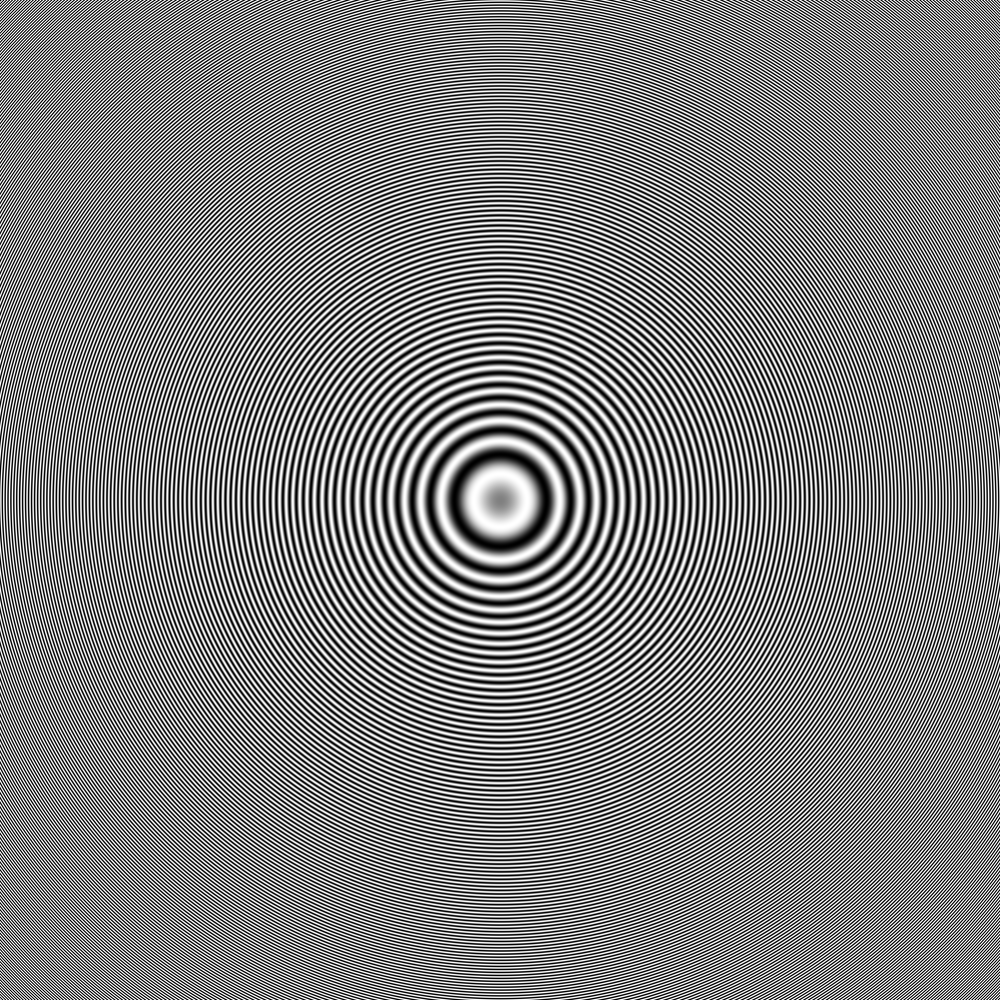
Load this file (or from this alternate location). It's a black-and-white image of concentric rings which get increasingly small and close as the they get further from the center circle.
There's nothing particularly magic about this image: anything which produces a moire pattern on an LCD screen should work, but this one is designed to give good results in many situations. Bart van der Wolf also produced an earlier moire target design which some people apparently find works better.
Steps
Setup and familiarization:
- Load the target pattern at 1:1 / 100% view in any image viewer — your web browser will do, but make sure it's showing the image unscaled.
- Set up your camera on a tripod perpendicular and at the appropriate distance away from the screen
- Camera-to-subject distance should ideally be no less than 50 times the focal length of the lens. For a 50mm lens, that would be at least 2.5 meters (25m for a 500mm).
- Turn on liveview and magnify until the image is close to filling the screen.
- In manual focus mode, adjust the focus distance and become familiar with the maximum interference pattern
Method 1:
- Go to the point of maximum interference. You do this by focusing manually (contrast detect may not be as precise, but you can try).
- Switch to phase detect and push the AF button.
- If the focus changes, dial in microadjustment in the correct direction and repeat.
Method 2 (more accurate, in my opinion):
- Set focus to infinity or closest focus.
- Autofocus using phase detection. Some cameras let you do this while in liveview.
- In liveview, manually adjust focus to see if it was front or back focused.
- If so, adjust and repeat.
Troubleshooting
If you can't see a moire effect, see these tips, which are, in summary:
- If the focus is too far off, it won't work.
- You could be too close for the focal length.
- You could be too far away for the focal length.
- The lens has poor resolution.
- The lens's manual focus control is too coarse to nail the spot.
Check more discussion of this question.